
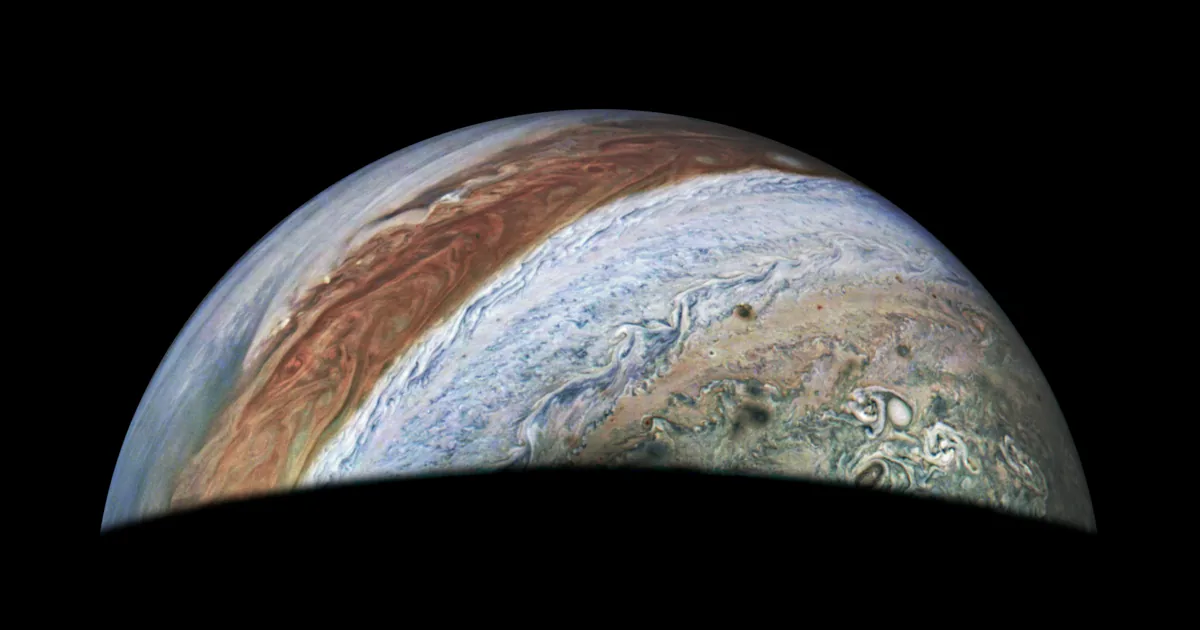
NASA’s Juno spacecraft has been orbiting Jupiter since 2016 and is one of the most successful planetary missions of recent decades. Originally planned to operate for about 20 months, it has now been active at the solar system’s largest planet for more than ten years. Juno has fundamentally changed our view of Jupiter’s interior and, during its mission extensions, also studied the large moons up close. Until Europa Clipper arrives in 2030, it is the only active spacecraft at Jupiter.
Juno at a Glance
| Property | Value |
|---|---|
| Operator | NASA (JPL, led by Southwest Research Institute) |
| Launch | 5 August 2011 on an Atlas V rocket |
| Arrival at Jupiter | 4 July 2016 |
| Orbit | polar, highly elliptical; close passes a few thousand kilometers above the clouds |
| Power | three solar arrays, the first solar-powered spacecraft at Jupiter |
| Radiation protection | titanium vault of about 200 kg for the sensitive electronics |
| Mission phases | prime mission to 2021, first extension 2021–2025, second extension since October 2025 |
| Status | active |
The Mission: Get Close, Then Get Away
Jupiter has the strongest magnetic field of any planet. It traps charged particles and creates radiation belts that are deadly for electronics. Juno therefore does not orbit over the equator like earlier spacecraft but on highly elliptical paths over the poles. On each close pass it dives from pole to pole a few thousand kilometers above the clouds, then swings far out, away from the worst radiation.
Juno was originally meant to circle Jupiter every 14 days. Because of a problem with valves in its main engine, NASA skipped the planned braking maneuver in 2016, and Juno stayed in its initial orbit of about 53 days. The science goals could still be met, just over a longer period.
A New View of Jupiter
A Diluted Core
Before Juno, many models assumed a small, dense rocky core. Juno’s gravity measurements showed something different: a “diluted” core, with heavy elements spread across almost half of the planet’s radius and mixed with metallic hydrogen. This points to a turbulent formation, possibly including a giant impact early on.
Deep Winds and Polar Cyclones
Jupiter’s cloud bands are not a surface phenomenon: its jet streams reach about 3,000 km deep, and the Great Red Spot is rooted several hundred kilometers below the visible clouds. Over the poles, which had barely been observed before, Juno discovered geometric arrangements of large cyclones; at the north pole, eight cyclones surround a central vortex.
“Mushballs” and Shallow Lightning
High in the atmosphere, ammonia and water ice form slushy hailstones known as “mushballs”. They fall deep into the atmosphere, carrying ammonia downward. The same process explains “shallow lightning” occurring at much higher altitudes than thought possible.
The First Extension: Visiting the Galilean Moons
From 2021, gradual changes to its orbit also turned Juno into a moon explorer:
- Ganymede (June 2021): a flyby at about 1,000 km altitude, the first close-up images since Galileo and measurements of the magnetic field of the solar system’s largest moon.
- Europa (September 2022): a flyby only about 350 km above the surface. From microwave radiometer data, researchers determined in 2025 that the cold, rigid outer ice layer in the observed region is about 29 km thick. If warmer, deformable ice lies beneath, the total shell is even thicker; if the ice contains salt, somewhat thinner.
- Io (December 2023 and February 2024): two flybys at about 1,500 km with the sharpest images yet of lava lakes and volcanoes on the most active body in the solar system.
The Second Extension: Rings and Inner Moons
A second mission extension began in October 2025 and currently runs to 2028. Its funding was uncertain for a while, but the 2026 US budget secured continued operations. In this phase, Juno is studying the inner radiation belts, the faint rings and the small inner moons. In spring 2026, a close flyby of the moon Thebe returned the sharpest images yet of this body, only about 100 km across.
Juno was originally meant to be steered into Jupiter’s atmosphere at the end of its mission, so that it could never crash onto the potentially habitable moon Europa. NASA has since dropped this plan: Juno will keep orbiting Jupiter until contact is lost.
What Comes Next at Jupiter
The next spacecraft are already on their way. Europa Clipper (NASA) reaches Jupiter in April 2030 and will study Europa during 49 flybys. ESA’s JUICE follows in July 2031 and will enter orbit around Ganymede in 2034. Juno’s measurements, such as the thickness of Europa’s ice, are already helping to plan these missions. The earlier history of Jupiter exploration is covered in the article on the Galileo mission.
Sources
- NASA: Juno mission
- NASA JPL: Juno measures the thickness of Europa’s ice shell (2025)
- NASA JPL: Juno mission extension
- Southwest Research Institute: Mission Juno
More about the planet: Jupiter facts, data and profile.