Venus: The Planet of Scorching Heat
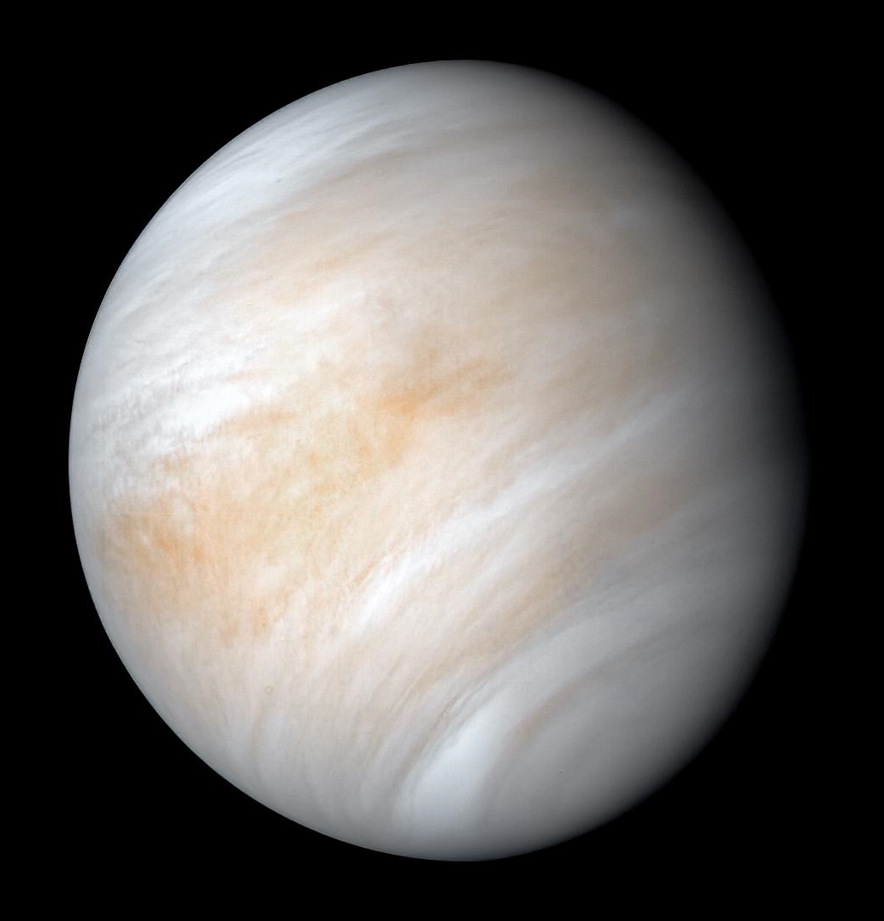
Venus is the second planet from the Sun and the one most similar to Earth in size and mass, which is why it is often called Earth’s “sister planet”. Yet conditions could hardly be more different: a dense carbon dioxide atmosphere with clouds of sulfuric acid drives an extreme greenhouse effect. At around 464 °C, Venus is the hottest planet in the solar system, even hotter than Mercury, which orbits closer to the Sun, and the pressure at its surface is 92 times that on Earth.
Because the clouds hide the ground, the surface could only be mapped by radar and studied directly by a handful of landers. In our sky, however, Venus is the brightest object after the Sun and the Moon, shining as the “morning star” or “evening star”. For an overview of its exploration, from the Soviet Venera probes to the missions planned by NASA and ESA, see the article on Venus exploration missions.
Venus at a Glance
| Property | Value |
|---|---|
| Type | Rocky (terrestrial) planet |
| Diameter (equatorial) | 12,104 km (0.95 × Earth) |
| Mass | 4.87 × 10²⁴ kg (0.815 Earth masses) |
| Mean density | 5.24 g/cm³ |
| Surface gravity | 8.87 m/s² (0.90 g) |
| Mean distance from the Sun | 108.2 million km (0.723 AU) |
| Closest / farthest from the Sun | 107.5 / 108.9 million km |
| Orbital eccentricity | 0.007 (most circular orbit of all planets) |
| Orbital period | 224.7 days |
| Rotation period (sidereal) | 243.0 days, retrograde |
| Solar day | 116.75 days |
| Axial tilt | 177.4° (equivalent to retrograde spin) |
| Surface temperature | approx. 464 °C (almost the same day and night) |
| Atmosphere | 96.5% carbon dioxide, 3.5% nitrogen; sulfuric acid clouds; surface pressure 92 bar |
| Magnetic field | No global intrinsic magnetic field |
| Moons | 0 |
| Rings | None |
| Spacecraft | incl. Venera (1961–1984), Magellan (1990–1994), Venus Express (2006–2014), Akatsuki (2015–2025); planned: DAVINCI, VERITAS, EnVision |
Atmosphere and Runaway Greenhouse Effect
Venus has the densest atmosphere of all rocky planets. It is 96.5% carbon dioxide (CO₂) and produces a surface pressure of 92 bar, equal to the water pressure about 900 meters below the ocean surface. The CO₂ lets some sunlight through but traps almost all of the heat radiated by the surface: a runaway greenhouse effect.
The result is a surface temperature of about 464 °C, hot enough to melt lead. Because the thick atmosphere spreads heat very evenly, the night side and the poles are hardly cooler than the day side. Between about 45 and 70 km altitude lies a continuous cloud deck of sulfuric acid droplets. It reflects roughly three quarters of the incoming sunlight, which is why Venus shines so brightly. The upper cloud layers circle the planet in only about four days, much faster than Venus itself rotates (superrotation).
Retrograde Rotation
Venus rotates extremely slowly and backwards, opposite to its direction of orbit around the Sun. One rotation takes 243 Earth days, longer than its year of almost 225 days. Combined, rotation and orbit produce a solar day of 116.75 Earth days. On Venus, the Sun rises in the west and sets in the east. Why Venus spins this way is not settled; a giant impact early in its history and solar tides acting on the dense atmosphere are among the explanations discussed.
Surface and Volcanism
Radar maps, above all from NASA’s Magellan spacecraft, reveal a volcanic world with vast lava plains. With only about 1,000 impact craters, the surface is geologically young, commonly estimated at a few hundred million years.
- Volcanoes: thousands of volcanoes, including large shield volcanoes such as Maat Mons, at about 8 km the highest volcano on Venus.
- Active volcanism: new analyses of old Magellan radar data revealed a changing vent on Maat Mons in 2023 and fresh lava flows at Sif Mons and in Niobe Planitia in 2024. Venus is therefore very likely still volcanically active today.
- Few small craters: smaller meteoroids burn up or break apart in the dense atmosphere before reaching the ground.
- Coronae and tesserae: ring-shaped structures probably formed above rising magma, and heavily deformed, rugged highlands.
There is no sign of Earth-like plate tectonics. Instead, Venus may lose its internal heat through volcanism and a slowly deforming crust.
Internal Structure and Magnetic Field
Inside, Venus is probably similar to Earth: an iron-nickel core, a rocky mantle and a crust. However, it has no global magnetic field of its own. One reason may be that its core lacks the convection a dynamo needs. Instead, the solar wind striking the upper atmosphere creates a weak, “induced” magnetosphere. Over billions of years, Venus has probably lost most of its water to space this way.
Observing Venus
As an inner planet, Venus never strays more than about 47° from the Sun. It appears either as the evening star in the west after sunset or as the morning star in the east before sunrise, reaching up to magnitude −4.9. It is so bright that it is easy to spot even in twilight and from light-polluted cities.
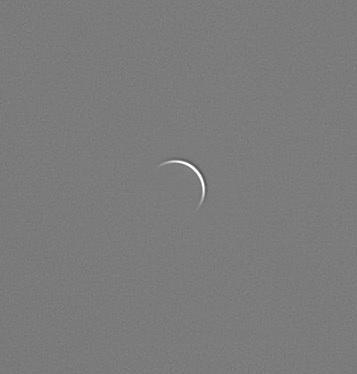
Even a small telescope or binoculars show the phases of Venus, first observed by Galileo Galilei in 1610 and a key piece of evidence for the heliocentric model. Near inferior conjunction, Venus appears as a large, thin crescent. Surface details are hidden by the clouds in visible light.
- Inferior conjunction: 24 October 2026, after which Venus moves into the morning sky.
- Greatest brilliancy in the morning sky: around 27 November 2026 (magnitude −4.9).
- Greatest western elongation: 3 January 2027 (47° west of the Sun).
- Transits of Venus: the last passages across the solar disk took place in 2004 and 2012; the next will not occur until December 2117.
Space Missions to Venus
Venus was the first target of interplanetary spaceflight, but the extreme surface conditions still make landings very difficult.
- Venera (USSR): Venera 7 made the first landing on another planet with data transmission in 1970; Venera 13 returned the first color images in 1982 and survived for 127 minutes.
- Magellan (NASA): mapped about 98% of the surface by radar from 1990 to 1994.
- Venus Express (ESA): studied the atmosphere and clouds from 2006 to 2014.
- Akatsuki (JAXA): observed Venus’s weather from 2015. After contact was lost in 2024, JAXA declared the mission over in September 2025.
- Planned: NASA’s DAVINCI (atmospheric probe) and VERITAS (radar orbiter) are to launch in the early 2030s; the US Congress confirmed their funding in the 2026 budget. ESA’s EnVision is scheduled to launch in 2032 and reach Venus in 2034.
Read more in the article Exploring Venus: A History of Extreme Challenges.