Jupiter: The Gas Giant and Guardian of the Solar System
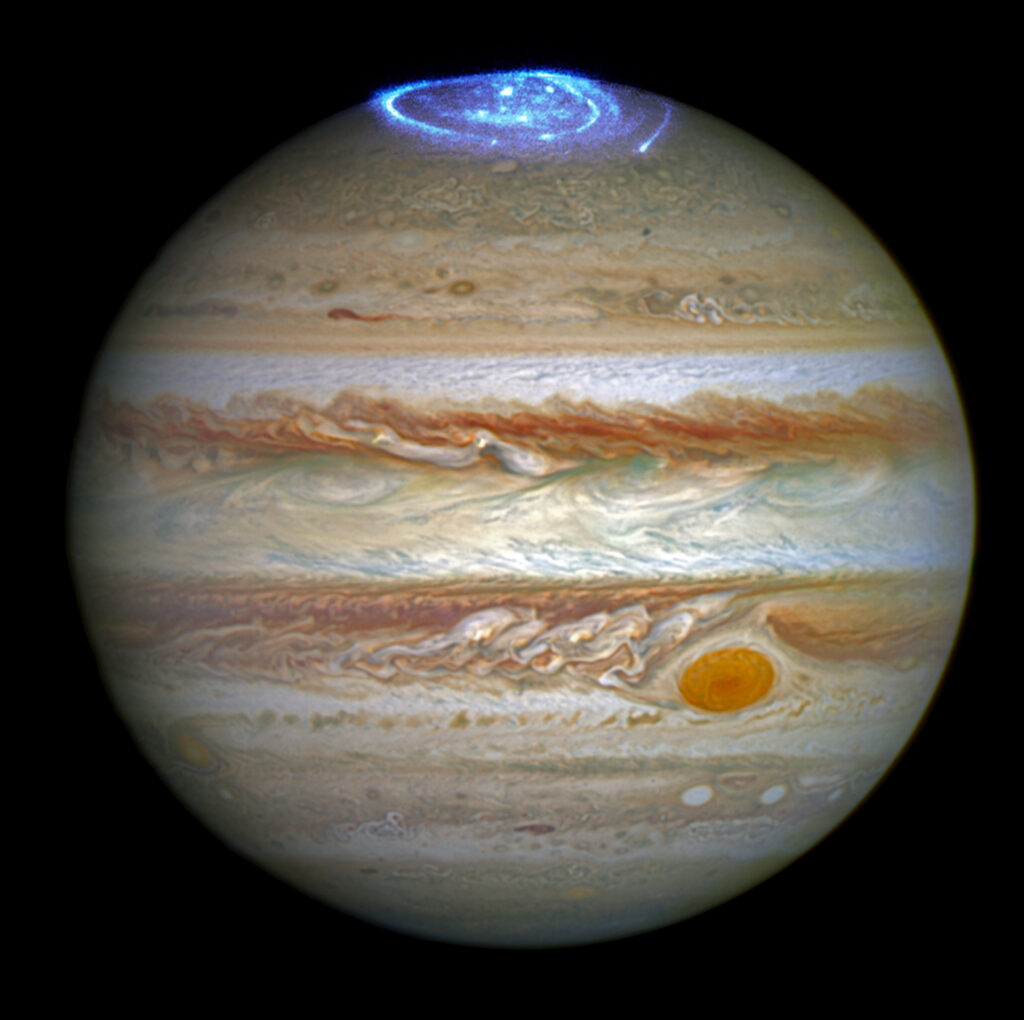
Jupiter is the fifth planet from the Sun and by far the largest. At 318 Earth masses, it is more than twice as massive as all the other planets combined. As a gas giant, it consists almost entirely of hydrogen and helium and has no solid surface. Deep inside, the hydrogen becomes metallic and electrically conducting under enormous pressure, generating the strongest magnetic field of any planet.
A day on Jupiter lasts less than ten hours. This fast spin visibly flattens the planet and organizes its atmosphere into bright zones and dark belts. Its most famous feature is the Great Red Spot, a storm larger than Earth. With 115 known moons, including the four large Galilean moons Io, Europa, Ganymede and Callisto, plus a faint ring system, Jupiter forms a small planetary system of its own.
Jupiter at a Glance
| Property | Value |
|---|---|
| Type | Gas giant |
| Diameter (equatorial) | 142,984 km (11.2 × Earth) |
| Mass | 1.898 × 10²⁷ kg (318 Earth masses) |
| Mean density | 1.33 g/cm³ |
| Gravity (1-bar level) | 24.8 m/s² (2.5 g) |
| Mean distance from the Sun | 778.5 million km (5.20 AU) |
| Closest / farthest from the Sun | 740.6 / 816.4 million km |
| Orbital eccentricity | 0.049 |
| Orbital period | 11.86 years |
| Rotation period | 9 h 55 min (fastest of all planets) |
| Axial tilt | 3.1° |
| Temperature | approx. −110 °C (1-bar level) |
| Atmosphere | approx. 90% hydrogen, 10% helium; traces of methane, ammonia and water |
| Magnetic field | Strongest of all planets; about 14 times Earth’s field at the cloud tops |
| Moons | 115 (as of April 2026) |
| Rings | Faint ring system made of dust |
| Spacecraft | Pioneer 10 and 11, Voyager 1 and 2, Galileo (1995–2003), Juno (since 2016); en route: Europa Clipper (arrival 2030), JUICE (arrival 2031) |
Internal Structure: A Planet Without a Surface
Jupiter has no solid surface. Below the clouds, pressure and temperature rise steadily until, a few thousand kilometers down, hydrogen turns into a liquid, metallically conducting state. Measurements by the Juno spacecraft show that the core is not sharply defined but “diluted”: heavy elements are spread through a large part of the interior. This points to a turbulent formation history, possibly including a giant impact.
Jupiter radiates almost twice as much energy as it receives from the Sun. The heat is left over from its formation and from the slow contraction of the planet.
Atmosphere and the Great Red Spot
Jupiter’s stripes consist of bright zones of rising gas and ammonia-ice clouds and dark belts of sinking gas. Jet streams between them reach more than 500 km/h in places. According to Juno data, these wind systems extend about 3,000 km deep into the planet. At both poles, stable clusters of large cyclones circle; at the north pole, eight cyclones surround a central vortex.
The Great Red Spot is a giant high-pressure storm in the southern hemisphere. In 2017 it was about 16,000 km wide, roughly 1.3 times Earth’s width, and it has been shrinking for more than a century. Its roots reach several hundred kilometers deep. It has been observed continuously since 1831; whether it is the same “permanent spot” that Giovanni Cassini described from 1665 onward is questioned by recent research.
Jupiter’s Role in the Solar System
As the most massive planet, Jupiter shapes the orbits of many small bodies. It holds the Trojan asteroids in its orbit, carves gaps in the asteroid belt and deflects or captures comets. In 1994, astronomers watched the fragments of comet Shoemaker-Levy 9 slam into its atmosphere.
According to the Grand Tack hypothesis, the young Jupiter first migrated inward, to about the current orbit of Mars, before Saturn pulled it back outward. This could explain why Mars stayed so small. Whether Jupiter on balance shields Earth from impacts or sends additional comets our way is debated among researchers.
The Galilean Moons and Other Moons
Galileo Galilei discovered the four large moons that now bear his name in 1610. Most of the remaining 115 known moons are only a few kilometers across; many are captured small bodies on distant, often retrograde orbits.
- Io: the most volcanically active body in the solar system, with more than 400 active volcanoes, powered by tidal heating.
- Europa: beneath its icy crust lies a salty ocean that probably holds about twice as much water as all of Earth’s oceans. It is considered one of the most promising places to search for life.
- Ganymede: at 5,268 km across, the largest moon in the solar system, bigger than the planet Mercury, and the only moon with its own magnetic field.
- Callisto: an ancient, heavily cratered ice world that has been almost inactive geologically for billions of years.
Magnetic Field and Radiation Belts
Jupiter’s magnetic field is the strongest of all planets; its magnetic moment is about 20,000 times that of Earth. On the side facing away from the Sun, the magnetosphere reaches beyond the orbit of Saturn and, if we could see it, would look larger than the full Moon in our sky.
The field traps charged particles, mainly sulfur and oxygen ions from Io’s volcanoes, and accelerates them to very high energies. The resulting radiation belts are a major challenge for any spacecraft. Jupiter’s auroras are permanent and are driven mainly by the planet’s rapid rotation and its interaction with Io.
Observing Jupiter
After Venus, Jupiter is usually the brightest planet in the night sky, reaching up to magnitude −2.9. Even binoculars show the four Galilean moons as points of light whose positions change from night to night. A small telescope reveals the flattened disk with its dark cloud belts and, in good seeing, the Great Red Spot and the shadows of moons crossing the planet.
- Next opposition: 11 February 2027, magnitude −2.6.
- After that: 12 March 2028 and 12 April 2029. Oppositions occur about every 13 months.
Exploration of Jupiter
Nine spacecraft have visited Jupiter so far, and two more are on their way.
- Pioneer 10 and 11 (1973/1974): the first spacecraft at Jupiter.
- Voyager 1 and 2 (1979): discovered the ring system and the volcanoes on Io. More in the article on the Voyager mission.
- Galileo (1995–2003): the first orbiter, which also dropped a probe into the atmosphere. More on the Galileo mission.
- Juno (since 2016): orbits Jupiter on polar orbits, measuring its gravity, magnetic field and atmosphere, and now also flies past its moons. More on the Juno mission.
- Europa Clipper (NASA): launched in October 2024, it reaches Jupiter in April 2030 and will study Europa during almost 50 flybys. More on the Europa Clipper mission.
- JUICE (ESA): launched in 2023, arriving in July 2031. The spacecraft is to enter orbit around Ganymede in 2034.