Uranus: The Ice Giant with the Tilted Axis
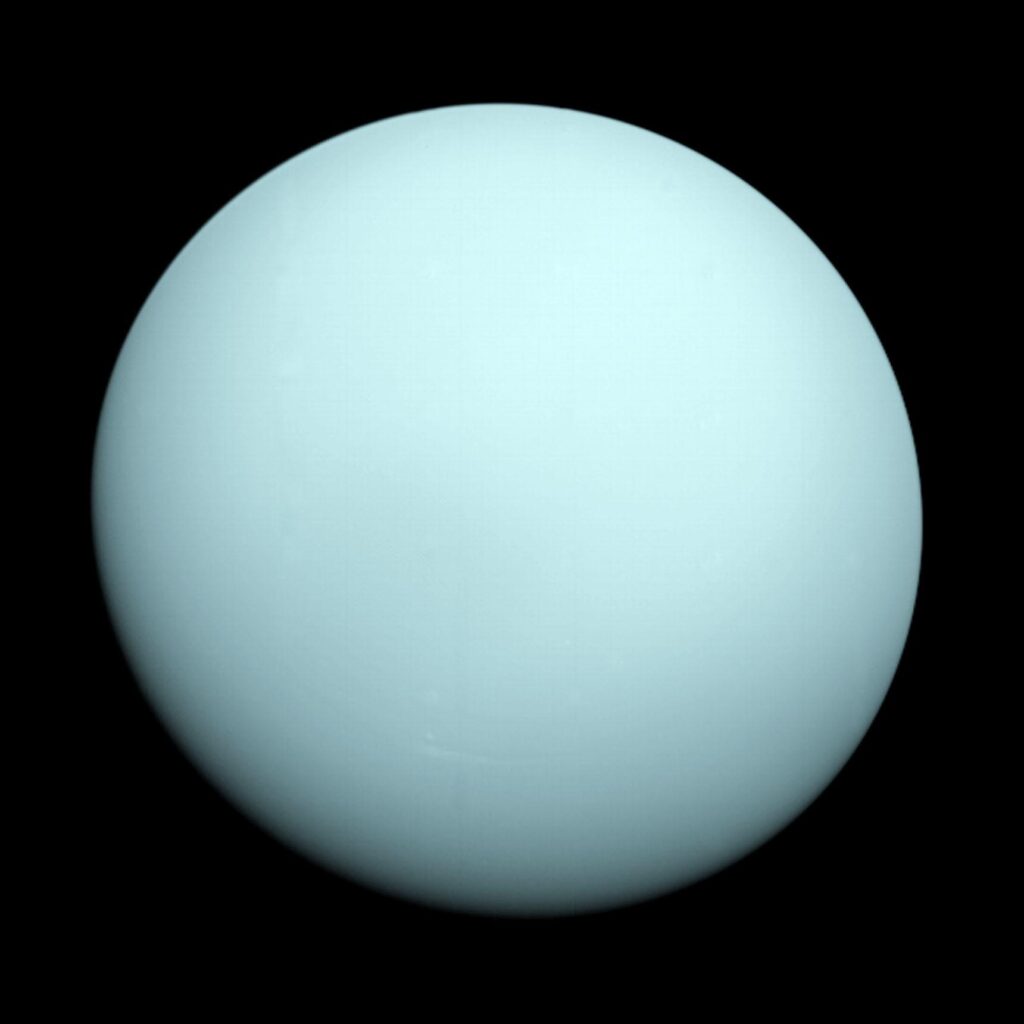
Uranus is the seventh planet from the Sun and the first to be discovered with a telescope: William Herschel found it in 1781. As an ice giant, it differs clearly from Jupiter and Saturn. Beneath an atmosphere of hydrogen, helium and methane lies a thick mantle of water, ammonia and methane, so-called “ices” in a hot, fluid state, surrounding a rocky core. The methane absorbs red light and gives the planet its pale blue to greenish color.
Its axial tilt of about 98° is unique: Uranus essentially rolls around the Sun on its side. As a result, each pole faces the Sun continuously for about 42 years and then spends just as long in darkness. With lows of around −224 °C, Uranus has the coldest atmosphere of any planet. It is surrounded by 13 narrow, dark rings and 29 known moons, named after characters by William Shakespeare and Alexander Pope.
Uranus at a Glance
| Property | Value |
|---|---|
| Type | Ice giant |
| Diameter (equatorial) | 51,118 km (4.0 × Earth) |
| Mass | 8.68 × 10²⁵ kg (14.5 Earth masses) |
| Mean density | 1.27 g/cm³ |
| Gravity (1-bar level) | 8.87 m/s² (0.90 g) |
| Mean distance from the Sun | 2.87 billion km (19.2 AU) |
| Closest / farthest from the Sun | 2.73 / 3.00 billion km |
| Orbital eccentricity | 0.047 |
| Orbital period | approx. 84 years |
| Rotation period | 17 h 14 min 52 s, retrograde |
| Axial tilt | 97.8° (rotates on its side) |
| Temperature | approx. −195 °C (1-bar level), minimum approx. −224 °C |
| Atmosphere | approx. 83% hydrogen, 15% helium, 2% methane |
| Magnetic field | Tilted 59° from the rotation axis and strongly offset from the planet’s center |
| Moons | 29 |
| Rings | 13 narrow, dark rings |
| Spacecraft | Voyager 2 (flyby 1986); no other mission so far |
Internal Structure: An Ice Giant
Uranus and Neptune form their own class of planets, the ice giants. Only a small part of their mass is hydrogen and helium. Most of it is a mantle of water, ammonia and methane which, despite the name, is not frozen but a hot, dense fluid under high pressure. At the center there is probably a core of rock and ice roughly the size of Earth.
Unlike Jupiter, Saturn and Neptune, Uranus releases little heat from its interior. The reason is not fully understood but may be linked to the giant impact that may once have tipped it over.
The Tilted Axis and Extreme Seasons
With an axial tilt of 97.8°, Uranus lies practically on its side. The most likely explanation is a collision with a large body during the formation of the solar system. Over its 84-year orbit, the Sun therefore moves from the north pole across the equator to the south pole and back. Each pole experiences about 42 years of daylight and 42 years of night. The last equinox was in 2007; the next northern summer solstice is in 2028.
Its rotation period was redetermined in 2025 using long-term Hubble observations of its auroras: 17 hours, 14 minutes and 52 seconds, 28 seconds longer than the value derived from Voyager data.
Atmosphere, Color and Temperature
The atmosphere consists mostly of hydrogen and helium with about 2% methane. Methane absorbs red light, leaving a pale blue-green. A reanalysis of Voyager and telescope data in 2024 showed that Uranus and Neptune are actually almost the same greenish-blue color; Uranus looks slightly paler because of a thicker haze layer. Its color also shifts slightly with the seasons.
In the upper troposphere, the temperature drops to about −224 °C, the lowest of any planetary atmosphere, even though Uranus is closer to the Sun than Neptune. After decades of an apparently bland appearance, Hubble, Keck and the James Webb Space Telescope now reveal cloud bands, storms and a bright polar cap.
Rings and Moons
The 13 rings were discovered in 1977, when Uranus passed in front of a star that briefly dimmed several times. They are narrow and very dark and probably consist of ice darkened by radiation.
Of the 29 known moons, five are large enough to be nearly round. The newest addition, a moon only about 10 km across, was discovered in 2025 with the James Webb Space Telescope.
- Titania: at 1,578 km, the largest moon of Uranus.
- Oberon: the outermost large moon, heavily cratered.
- Ariel and Umbriel: Ariel is bright and crossed by valleys, Umbriel is the darkest of the large moons.
- Miranda: the smallest of the five, with a jumbled surface and the cliff Verona Rupes, which may be up to 20 km high.
Magnetic Field
Voyager 2 found that the axis of the magnetic field is tilted 59° from the rotation axis and offset from the center by about a third of the planet’s radius. The field is therefore probably generated not in the core but in a conducting layer of the fluid mantle. A 2024 study also showed that Voyager 2 passed the planet during a rare solar wind event that had strongly compressed the magnetosphere, so it is probably less unusual than the 1986 data suggested.
Observing Uranus
At around magnitude 5.7, Uranus is at the limit of naked-eye visibility and can only be seen without optical aid under very dark skies. With binoculars and a finder chart it is easy to locate; it is currently in the constellation Taurus. A telescope shows a tiny greenish-blue disk just under 4 arcseconds across, without visible detail.
- Next opposition: 25 November 2026, magnitude +5.6.
- After that: 30 November 2027 and 3 December 2028.
Exploration of Uranus
Only one spacecraft has ever visited Uranus: Voyager 2 flew past in January 1986, discovered ten new moons and two new rings and made the first measurements of its magnetic field. More in the article on the Voyager mission. Since then, all new findings have come from space telescopes such as Hubble and James Webb and from large ground-based telescopes.
An orbiter with an atmospheric probe, the “Uranus Orbiter and Probe”, was recommended in the 2022 US decadal survey as the top new flagship mission in planetary science. However, no such mission has been approved or funded yet.