Documentation of the Solar Imaging System (SIS)
The data presented within the Solar Data Archive is generated by a dedicated, white-light Solar Imaging System (SIS). This documentation details the specific hardware configuration and standardized acquisition protocol employed to ensure the consistency and scientific integrity of daily solar observations of the photosphere.
1. System Development History
The current system configuration is the result of a staged evolution from a consumer-grade platform to a specialized astronomical instrument focused on high-resolution solar detail.
- Initial Configuration (Start of Archive): Data acquisition began using a standard DSLR camera coupled with a variable-focal-length 70-300mm telephoto lens on a tripod. This configuration was utilized for foundational experience and broad documentation of the photosphere and large-scale sunspot groups.
- Current Configuration (Deployment): The system was upgraded to a fixed-focal-length setup utilizing a dedicated monochrome camera and specific narrow-band filtration. This transition maximizes resolving power and signal-to-noise ratio for accurate sunspot measurement and fine structure observation. The upgrade took place during mid August until the beginning of October 2025 and therefore there’s a gap in the data archive during this time.
2. Hardware and Optical Specifications
The current SIS is optimized for high-contrast, white-light imaging, focusing on the solar photosphere. While the system utilizes components designed for stability and high performance within its specific 62.5 mm aperture class, its scientific value is derived from the precision of the filtering and the post-processing protocol.
A. Optical Configuration
| Component | Model / Specification | Function |
|---|---|---|
| Primary Optic | Astromodified Beroflex 500mm f/8 Telephoto Lens (62.5 mm Aperture) | Fixed focal length. Provides stable optical performance. |
| Aperture Filter | Solar Filter Foil (Full Aperture) | Primary safety element; reduces incoming light >99.99% and blocks harmful UV/IR radiation. |
| Contrast Filter | Solar Continuum Filter (7.5nm Bandwidth) | Isolates a 7.5nm spectral band around 540nm (green light) to maximize contrast for sunspot penumbrae and granulation. |
| Safety Filter | UV/IR Cut Filter | Secondary filter placed near to the sensor plane to block residual non-visible radiation and mitigate image blurring. |
B. Digital Acquisition Platform
| Component | Model / Specification | Key Parameters |
|---|---|---|
| Camera Module | ToupTek G3M178M | Sensor: Sony IMX178M (Monochrome) |
| Sensor Resolution | 3096×2080 pixels (6.3 MP) | Pixel Size: Small pixels are ideal for sampling high-magnification solar details. |
| Data Format | SER Video Sequences | Utilized for “Lucky Imaging” protocol to overcome atmospheric turbulence. |
C. Equatorial Tracking Platform
The system requires stable, precision tracking to maintain the target within the small field of view during high-frame-rate video acquisition.
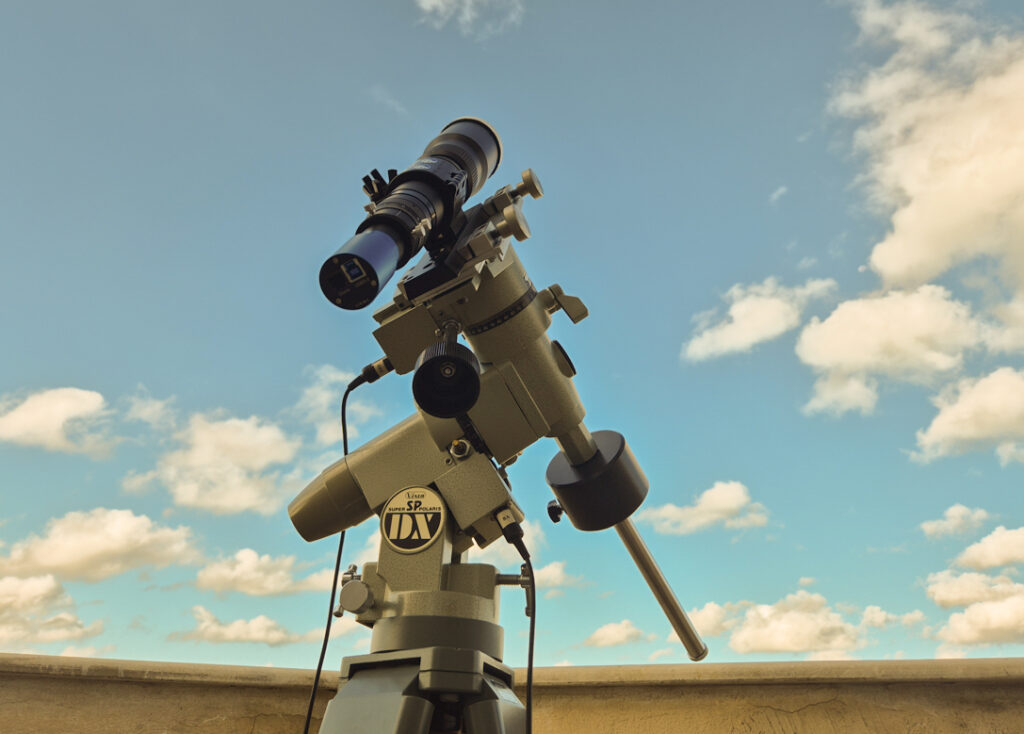
- Mount: Vixen SuperPolaris DX (SP-DX) Equatorial Mount
- Control: Motorization on Right Ascension (RA) and Declination (Dec) axes.
3. Capture and Processing
The daily workflow is now largely automated. From the video to the entry in the Solar Data Archive, every capture goes through these steps:
Capture (FireCapture) → Stacking (AutoStakkert!) → Orientation (SolarRotate) → Active region labels → Count → Database → archive, widget and charts
3.1 Capture
- Pointing: The optics are aimed at the Sun and tracked with the motorized SP-DX mount.
- Camera control: I run the G3M178M with FireCapture.
- Video: Each capture is a short SER video of about 250 frames at a short exposure time.
3.2 Stacking
AutoStakkert! rates every frame, aligns the best ones and adds them into a single TIF image. This lowers the noise and evens out brief blurring caused by atmospheric turbulence.
3.3 Orientation with SolarRotate
The stacked image is then processed by SolarRotate, a Python script I wrote for this:
- Limb and centre: The script detects the edge of the solar disk and derives the centre from it. Sunspots close to the limb do not distort the result.
- Solar north up: From the date and time it calculates the position angle P of the solar axis and rotates the image so that the Sun’s north pole is at the top.
- Standard format: The result is placed on a square image of 2150 × 2150 pixels, so all archive images can be compared directly.
3.4 Active Region Labels
For the first image of the day, SolarRotate also creates a labelled version. It downloads the current list of active regions from NOAA SWPC with heliographic latitude and Carrington longitude, and converts the positions onto the solar disk using the angles B0 and L0. Each NOAA number then sits next to its sunspot group. Until July 2026 I added the numbers by hand.
3.5 Count and Archiving
On the first image of the day I count the sunspot groups (g) and the individual spots (s), separately for the northern and southern hemisphere. I upload the image and the count to the Solar Data Archive database through a form. The archive, the solar widget on the home page and the chart on the Wolf sunspot number page all take their data from there. The database picks up the daily SILSO reference values once a month.