
Parker Solar Probe: Unlocking the Secrets of the Solar Corona
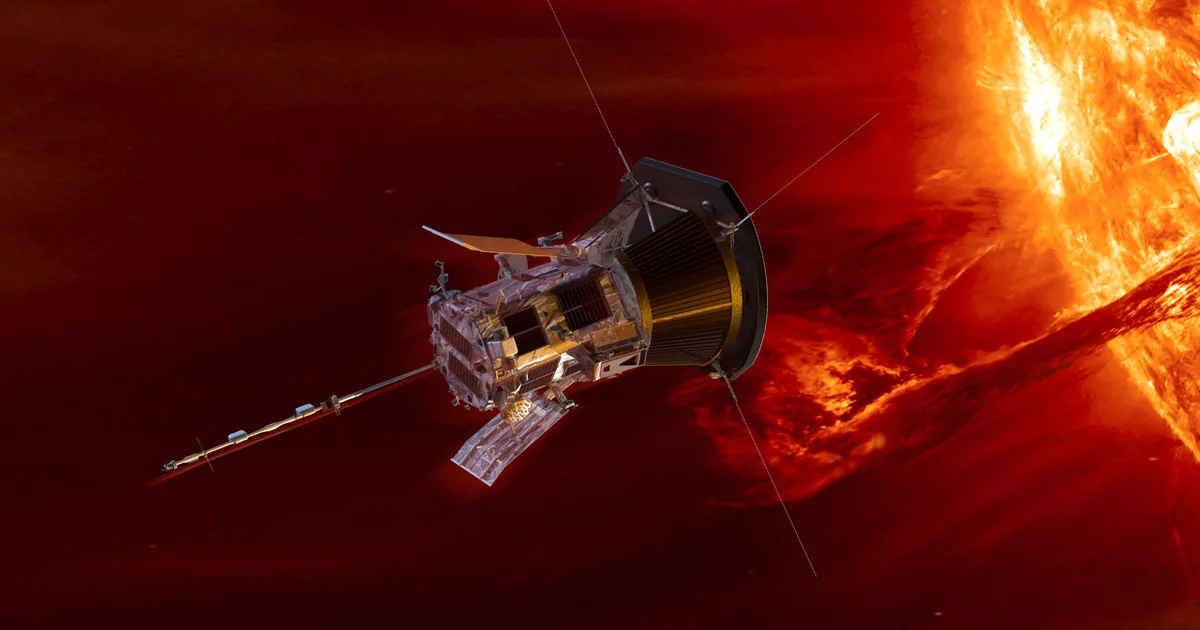
The Parker Solar Probe (PSP), launched by NASA on August 12, 2018, represents a monumental leap in heliophysics, the study of the Sun. Named after the pioneering astrophysicist Eugene Parker (1927–2022), who first theorized the existence of the solar wind and lived to see the launch, the mission is designed to penetrate the Sun’s outer atmosphere, the Corona, and provide the first-ever direct measurements from this extreme and volatile region. Parker Solar Probe is more than a spacecraft; it is a technological marvel engineered to withstand conditions previously deemed insurmountable, with the central goal of resolving two of the most enduring mysteries of our star.
| Milestone | Date | Details |
|---|---|---|
| Launch | August 12, 2018 | Delta IV Heavy, Cape Canaveral |
| First “touch” of the Sun | April 28, 2021 | first passage through the corona, below the Alfvén surface |
| Final Venus flyby | November 6, 2024 | puts the probe on its final orbit |
| Record perihelion | December 24, 2024 | 6.1 million km above the solar surface, 692,000 km/h |
| End of prime mission | June 2025 | after 24 perihelion passes |
| 29th perihelion | September 4, 2026 | one close pass every 88 days since |
| End of mission | 2029 at the earliest | extended mission |
Primary Mission Objectives: The Sun’s Greatest Puzzles
Parker Solar Probe’s scientific agenda is sharply focused on gathering in-situ data to solve fundamental questions about how the Sun works, which have broad implications for stellar physics across the universe.
1. The Coronal Heating Problem
This paradox lies at the heart of the mission. Contrary to thermodynamic principles, the Sun’s atmosphere dramatically increases in temperature as it moves away from the surface. While the Photosphere (the visible surface) maintains a relatively cool temperature of about 5,500 degrees Celsius (9,940°F), the outer Corona surges to temperatures between one and three million degrees Celsius.
Parker Solar Probe is collecting direct evidence to differentiate between the two primary mechanisms theorized to explain this superheating:
- Wave Heating: Energy is carried upwards from the turbulent surface via waves (specifically Alfvén waves) in the plasma, which then dissipate and release heat in the Corona.
- Magnetic Reconnection (Nanoflares): Explosive, small-scale events caused by the rapid, localized rearrangement of magnetic fields, generating immense heat bursts known as nanoflares.
2. The Origin and Acceleration of the Solar Wind
The Solar Wind is a perpetual stream of charged particles that flows outwards from the Corona, filling the solar system. This outflow dictates space weather and can impact planetary magnetospheres. Scientists distinguish between the slow solar wind (400 km/s) and the fast solar wind (up to 800 km/s), but the specific origin and the mechanism that accelerates this plasma to supersonic speeds remain unclear.
Since April 2021, PSP has regularly dipped below the Alfvén surface, the boundary where the solar material moves faster than the speed of the Alfvén waves, meaning it can no longer be magnetically tied to the Sun and becomes the solar wind. Direct measurements from this zone are crucial to identifying the magnetic structures and energy flows responsible for the wind’s acceleration.
Engineering a Close Encounter: Designed for Extremes
To achieve its unprecedented proximity to the Sun (approximately 3.8 million miles or 6.1 million kilometers from the surface, reached for the first time on December 24, 2024), the spacecraft required cutting-edge technology for thermal defense. At closest approach it races past the Sun at about 692,000 km/h (430,000 mph), making it the fastest object ever built.
The Thermal Protection System (TPS)
The cornerstone of the probe’s survival is the Thermal Protection System (TPS), a shield about 11.43 centimeters (4.5 inches) thick. This advanced shield is constructed from a carbon-carbon composite material, designed to endure the fierce heat and intense solar radiation.
- Exterior Challenge: During its closest flybys, the exterior of the shield is exposed to temperatures reaching nearly 1,400 degrees Celsius (2,550°F).
- Interior Sanctuary: Crucially, the shield ensures that the scientific instruments and core electronics in its shadow remain at a benign room temperature (around 30°C or 86°F).
Autonomy and Active Cooling
The probe operates autonomously using onboard computers to ensure the TPS is always perfectly aligned with the Sun, shielding the sensitive components. Additionally, the solar arrays, which generate power, employ an active cooling system that circulates pressurized water to shed excess heat, keeping the arrays functional despite the extreme environment.
Groundbreaking Scientific Discoveries
The mission has delivered transformative data, challenging established solar models and revealing a turbulent, highly complex near-Sun environment.
1. The Discovery of Magnetic Switchbacks
The most startling discovery is the frequent observation of “Switchbacks”: sudden, dramatic, and temporary reversals in the direction of the magnetic field lines flowing from the Sun.
- The Phenomenon: The magnetic field “kinks” back on itself in an S-shaped fashion, reversing its orientation before snapping back to its original configuration. These events were far more pronounced and localized near the Sun than expected.
- Significance: In 2021, switchbacks were traced back to funnel-shaped magnetic structures at the base of the corona. It is now strongly hypothesized that these Switchbacks are a key mechanism for accelerating the solar wind, injecting energy and momentum into the plasma particles as they leave the Corona.
2. Structured and Burst-Like Solar Wind Flow
Initial data revealed that the solar wind near its source is not a smooth, uniform stream as assumed, but is highly structured and often flows in “bursts” or jets originating from localized magnetic funnels in the Corona. This suggests that the processes launching the wind are highly localized and tied directly to specific magnetic geometries.
3. Approaching the Dust-Free Zone
Nearly 100 years ago, scientists predicted a dust-free zone close to the Sun, where interplanetary dust particles vaporize once they reach temperatures of about 1,800°C. The WISPR camera on Parker Solar Probe provided the first evidence: dust density drops noticeably from about 11 million kilometers from the Sun inward. According to models, the truly dust-free zone only begins a few million kilometers above the Sun, even closer than Parker gets.
4. Images from Inside the Corona
During the record flyby on December 24, 2024, WISPR photographed the corona from the inside. The images, released in July 2025, show coronal mass ejections and solar wind streams forming and colliding right at their source. Images from just a few million kilometers away had never been taken before.
Future Impact and Space Weather Forecasting
With its final Venus flyby in November 2024, Parker Solar Probe reached its final orbit. Since then it has passed within 6.1 million kilometers of the solar surface every 88 days, for the 29th time on September 4, 2026. The prime mission ended in June 2025, but NASA has extended the mission to at least 2029. This lets the probe follow the declining phase of Solar Cycle 25 up close, together with ESA’s Solar Orbiter, which observes the Sun from a little farther away and now also from a tilted vantage point above the ecliptic.
The knowledge gleaned from PSP holds profound practical value. By understanding the underlying mechanisms of the solar wind and Coronal Mass Ejections (CMEs), scientists can significantly improve Space Weather forecasting. The ability to predict severe solar storms is crucial for protecting modern technological infrastructure (including satellites, GPS systems, aviation, and power grids) from potentially catastrophic geomagnetic interference. The Parker Solar Probe is thus not only advancing science but also contributing an essential layer of protection to our technological civilization.
You can find more about the Sun on my page Sun.