

On the night of June 27, 2026, an asteroid roughly a kilometer across passed within 2.6 million kilometers of Earth — about 6.7 times the distance to the Moon. I pointed my telescope at it and captured its motion against the background stars over the course of the night. That asteroid, cataloged as (152637) 1997 NC1, is one of thousands of near-Earth objects astronomers track every year, and its flyby is a good excuse to explain what these objects actually are, how we find them, and how worried we should really be.
What Is a Near-Earth Object?
A near-Earth object, or NEO, is any asteroid or comet whose orbit brings it within about 1.3 astronomical units of the Sun — close enough that its path can bring it into Earth’s neighborhood. The vast majority of NEOs are asteroids rather than comets, leftover rocky and metallic debris from the formation of the solar system 4.6 billion years ago that never accreted into a planet. As of today, astronomers have cataloged well over 30,000 near-Earth asteroids, and new ones are found on a near-daily basis.
Most NEOs are small — tens to a few hundred meters across — and pose no danger whatsoever. Size matters enormously here: an object needs to be roughly 140 meters or larger before it could cause serious regional damage on impact, and only a relatively small fraction of NEOs reach that size.
How Near-Earth Objects Are Classified
Astronomers sort NEOs into four groups based on how their orbits relate to Earth’s:
Atira asteroids orbit entirely inside Earth’s orbit, never crossing it. Aten asteroids have orbits smaller than Earth’s on average but do cross Earth’s path — 1997 NC1 belongs to this group. Apollo asteroids have orbits larger than Earth’s on average and also cross Earth’s path; this is the largest and most closely watched group. Amor asteroids approach Earth’s orbit from outside but don’t quite cross it.
This classification matters because it shapes how often and how closely an object can approach Earth over long timescales, which feeds directly into risk assessment.
What Makes an Asteroid “Potentially Hazardous”?
The label “Potentially Hazardous Asteroid” (PHA) sounds alarming, but it’s a technical classification, not a prediction. An asteroid earns this designation if it meets two criteria: its minimum orbit intersection distance (MOID) with Earth is less than 0.05 astronomical units (about 7.5 million kilometers), and it’s large enough — roughly 140 meters or more — that an impact could cause significant damage. 1997 NC1 carries this label, and NASA’s own assessment for its June 2026 approach was unambiguous: there was no risk to Earth at all. The PHA classification simply means an object’s orbit warrants continued monitoring, not that a collision is expected or even plausible on any predictable timescale.
How We Find and Track Them
Nearly all NEO discoveries today come from a small number of dedicated survey programs that scan the sky repeatedly, comparing images to spot anything that moves against the fixed background of stars. The Catalina Sky Survey in Arizona and the Pan-STARRS and ATLAS surveys in Hawaii do most of the heavy lifting from the ground, while NASA’s NEOWISE spacecraft has scanned the sky in infrared from orbit, which is especially good at finding dark asteroids that reflect little visible light. A dedicated infrared survey telescope, NEO Surveyor, is set to join the effort to accelerate the search for the remaining undiscovered hazardous objects. 1997 NC1 itself was found decades ago by the Near-Earth Asteroid Tracking (NEAT) program, one of the earliest systematic search efforts, operating from Haleakala Observatory in Hawaii.
Once an object is discovered, its orbit is refined with follow-up observations — sometimes including radar, which was used to reveal that 1997 NC1 is actually a slowly rotating, peanut-shaped body about 950 meters long, more precise than the kilometer-scale estimate from optical observations alone.
Measuring a Close Approach: The Lunar Distance
Because the numbers involved are so large, astronomers usually describe close approaches in terms of lunar distances (LD) — multiples of the average Earth-Moon distance of about 384,400 kilometers — rather than raw kilometers. 1997 NC1’s June 2026 approach, at roughly 6.7 lunar distances, sounds close in headlines but is nowhere near actually close in orbital terms; for comparison, geostationary satellites orbit at a small fraction of a single lunar distance, and even a “close” asteroid pass like this one leaves an enormous safety margin.
Assessing Risk: The Torino Scale
To communicate impact risk to the public without either alarming people unnecessarily or downplaying genuine concerns, astronomers use the Torino Scale, a 0-to-10 rating that combines an object’s collision probability with the energy it would release on impact. The overwhelming majority of tracked NEOs, including 1997 NC1, sit at 0 — no hazard at all. The scale exists mainly to flag the rare cases where more attention or observation is warranted, and history shows why that vigilance matters: the 2013 Chelyabinsk event, in which a roughly 20-meter object entered the atmosphere over Russia undetected and injured around 1,500 people through the resulting shockwave, involved an object far too small to have been on anyone’s watch list at the time. Large, well-characterized objects like 1997 NC1 are, ironically, the safe ones — it’s the smaller, harder-to-find objects that represent the real gap in our current tracking capability.
Planetary Defense: From Theory to Practice
For most of the space age, planetary defense was purely theoretical. That changed on September 26, 2022, when NASA’s DART spacecraft deliberately collided with Dimorphos, the small moon of asteroid Didymos, in the first real-world test of a kinetic impactor. The impact shortened Dimorphos’s 12-hour orbital period around Didymos by 33 minutes — far more than the mission’s minimum success threshold — proving that a spacecraft impact can meaningfully alter an asteroid’s trajectory. Deflection missions like DART only work if we have years of advance warning, which is exactly why the discovery and tracking work described above matters so much.
Looking Ahead: Apophis in 2029
If 1997 NC1’s flyby caught your attention, mark your calendar for April 13, 2029. On that date, the asteroid Apophis — once briefly feared to be an impact risk when it was discovered in 2004 — will pass within about 32,000 kilometers of Earth’s surface, closer than many geostationary satellites. NASA has ruled out any impact risk for at least the next century, and the close pass will instead be a rare scientific opportunity: Apophis will be visible to the naked eye from parts of the world, and several spacecraft are expected to study it up close during the encounter.
My Own Observations of 1997 NC1
At around magnitude 10, 1997 NC1 was far too faint for the naked eye, but well within reach of amateur equipment. Over three nights, I captured its motion against the fixed background stars, observing for roughly 45-60 minutes each session with 30-second sub-exposures. I used a 500mm Beroflex lens paired with a ToupTek G3M178M camera, then stacked and lightly processed the frames in Siril.
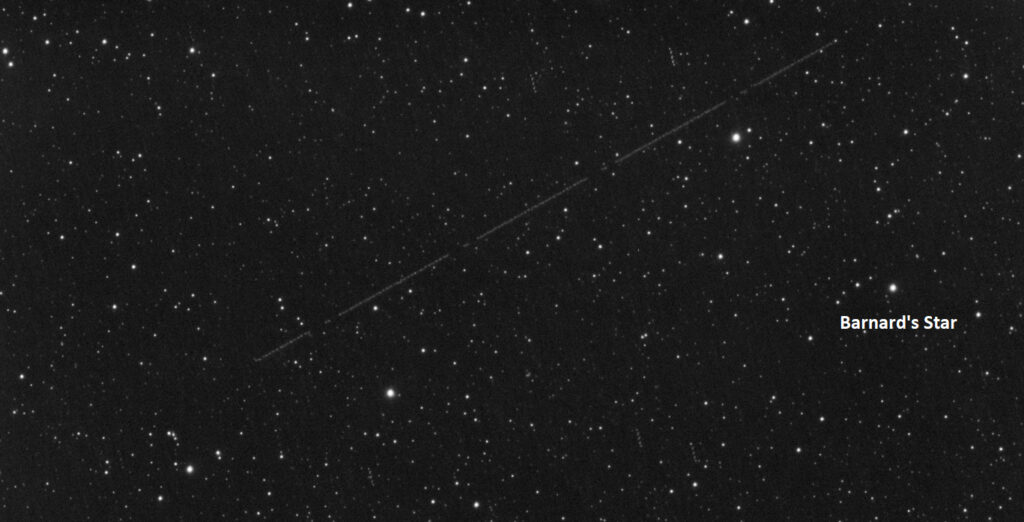
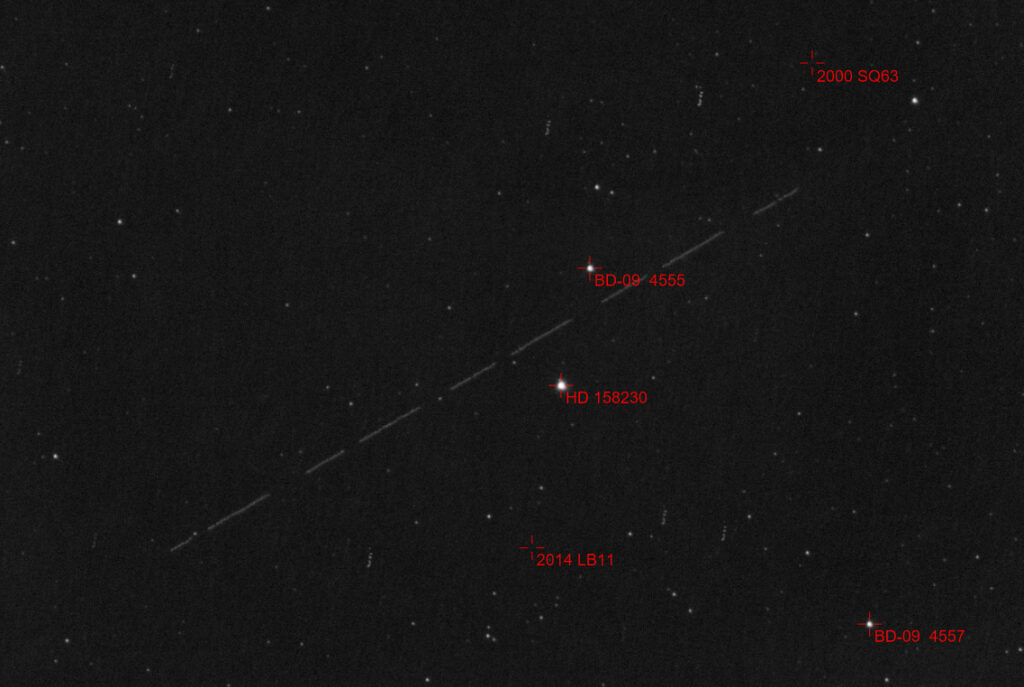
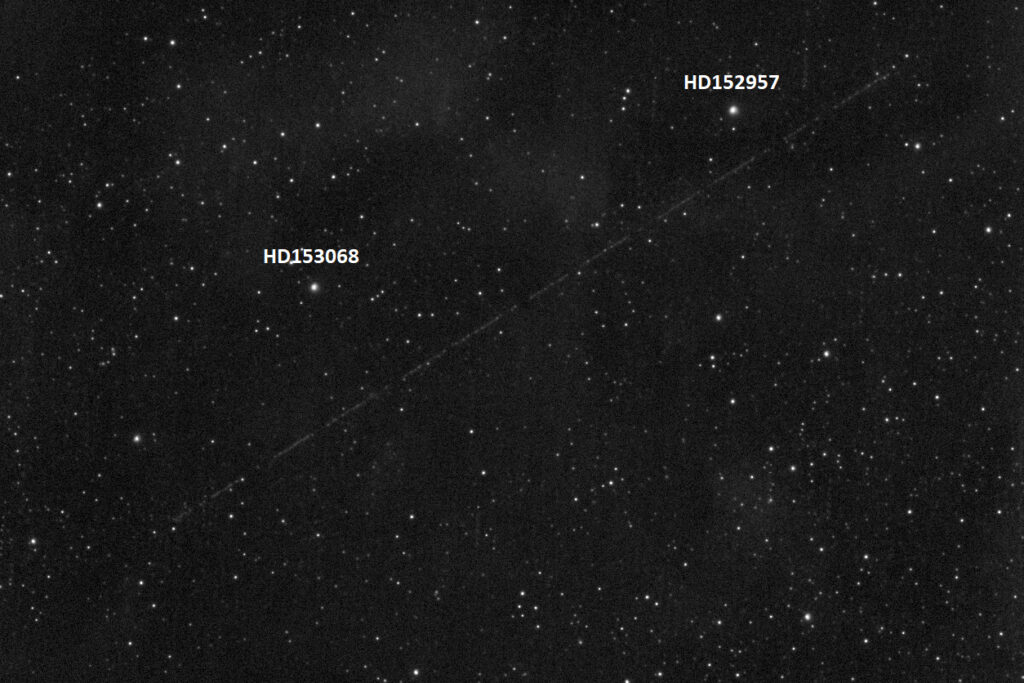
Tracking objects like this is a small example of what’s achievable with fairly simple amateur equipment. You can see a similar project on my T CrB nova monitoring page, where I track the recurrent nova T Coronae Borealis.
Why It Matters
None of this is really about fear — the overwhelming majority of near-Earth objects, including 1997 NC1, pose no threat at all, and the ones that could matter are being found, tracked, and better understood every year. What I find compelling is the scale of it: a piece of rock nearly as old as the solar system itself, quietly crossing Earth’s neighborhood, visible for one night through an ordinary backyard telescope if you know where to look.