
On 1 July 2026 a new star appeared in the constellation of Aquila, the Eagle: Nova Aquilae 2026, now V2104 Aql. At first glance it was inconspicuous: at around magnitude 11 at maximum, it was only visible in a telescope. The reason is not the nova itself but thick dust between it and us. I measured V2104 Aql almost every night from 4 July, the night of its maximum, until 2 August, in the V band and additionally with a red filter.
Discovery
The nova was discovered on 1 July 2026 at 07:19 UT by M. Ning and H. Lin in data from the Zwicky Transient Facility (ZTF), initially as the transient AT 2026rdg. The discovery values already stood out: magnitude 14.45 in the green g band, but 12.53 in the red r band. The nova was strikingly red. Spectra from 2 July showed broad emission lines of hydrogen and iron with P Cygni profiles: a classical Fe II-type nova, shortly before maximum. Soon afterwards it received the official name V2104 Aql.
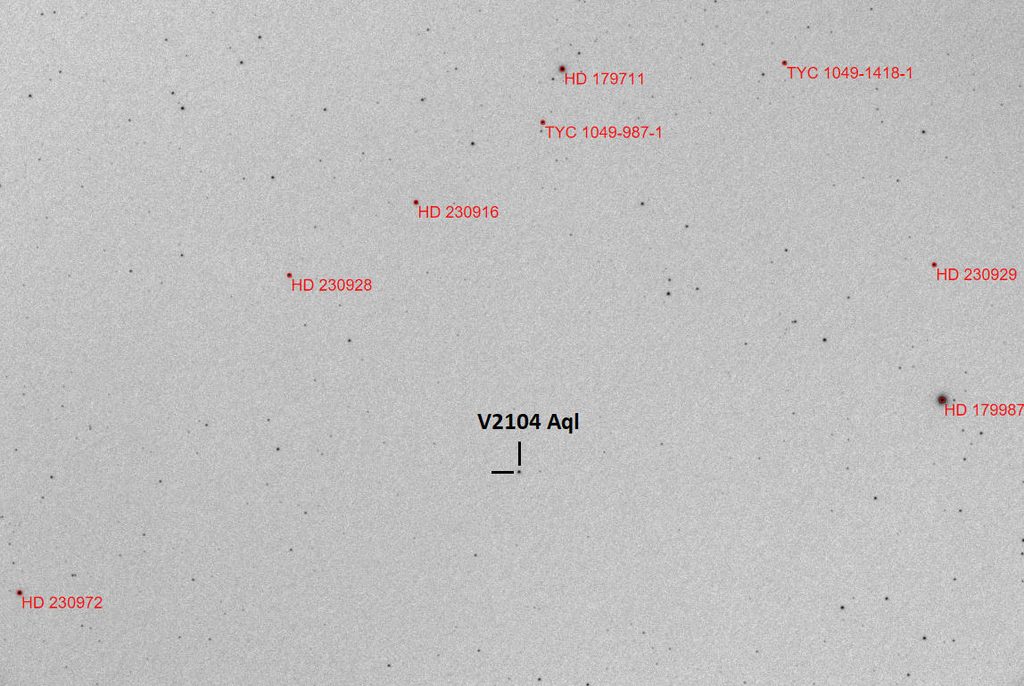
A nova behind thick dust
The red colour has a clear cause: on its way to us, the light of the nova has to pass through a lot of interstellar dust. The spectra show the typical traces of this: strong diffuse interstellar bands and absorption lines of interstellar sodium and potassium. From these, the Italian ANS Collaboration derives a reddening of E(B−V) = 2.45 ± 0.18 mag. That is a lot.
What this means can be estimated roughly: with the usual ratio of reddening to extinction (RV ≈ 3.1), the dust swallows around 7.6 magnitudes in the V band. The light is dimmed by a factor of about 1000. Without this dust, V2104 Aql would have peaked at about magnitude 3.4 and would have been easily visible to the naked eye. This is a back-of-the-envelope calculation, but it shows how much the dust in the plane of the Milky Way hides from us.
Maximum and decline
According to measurements by the ANS Collaboration, the nova reached its maximum in the V band on 4 July at about 22 UT at magnitude 11.04; before that there was a short standstill of about a day. My first measurement is from the same evening: 10.94. After that, the brightness fell steadily. It was two magnitudes below maximum after about 9 days (t2), in my data as in the ANS data. This makes V2104 Aql a “very fast” nova. By 2 August it had faded to magnitude 14.3 in V, a good three magnitudes below maximum.
On 16 July the ANS Collaboration reported an unexpected short rebound of 0.25 mag. I did not observe on exactly those nights. On 19 July, however, I see a similar, smaller jump: in V the nova was 0.14 mag brighter than the night before, in the red filter only 0.02 mag. Whether the two are related, I cannot say.
Two colours: V band and red filter
In addition to the V filter I used a red filter: a Wratten 25 filter combined with a UV/IR-cut filter. The Wratten 25 blocks short-wavelength light up into the orange, and the UV/IR-cut filter limits the passband towards the infrared. I do not know the exact transmission curve of this combination, but the strong red hydrogen line Hα at 656 nm certainly lies right inside it. I calibrated against the Rc values of the comparison stars. This is not a standard R filter; my red values are very stable in themselves, but cannot be compared directly with R or r′ values from other observers.
Comparing the two filters shows how the nova is changing: from 5 July to 2 August it faded by only 1.8 mag in the red filter, but by 2.8 mag in V. The colour V − red rose from 1.8 to 2.8 mag: the nova became steadily redder. This fits the spectra: while the continuum of the nova fades, the Hα line stays bright for a long time, and it lies in the middle of my red filter’s passband. The ANS Collaboration describes the same trend: V − R and V − I become redder during the decline.
How good are the measurements?
I observe with a 60 mm refractor and a monochrome camera with an IMX178 sensor, using AstroImageJ for differential photometry against comparison stars of known brightness. An additional check star always runs along as a test. In the red filter it deviates from its catalogue value by only 0.01 mag on average, with a scatter of 0.010 mag. In V the scatter is 0.026 mag. Here the check stars are fainter at magnitude 12.4 to 12.9, and towards the end the nova itself was fainter than magnitude 14.
Compared with the ANS Collaboration, my V values at maximum and at t2 are about 0.1 mag brighter. One possible cause is the extreme colour of the nova: the colour correction of my setup is determined on normal stars, and for such a red object with strong emission lines it becomes less accurate. In addition, I do not have a B filter. I took the nova’s B−V colour for this correction from measurements by other observers. The time evolution (maximum, t2 and decline) agrees well, however.
Sources
- Discovery, first spectra and photometry: ATel #17867 (ANS Collaboration), ATel #17868
- Maximum, t2, reddening E(B−V) and colour evolution: ATel #17900 (ANS Collaboration)
- Observing campaign with many telescopes: AstroNote 2026-233 (Transient Name Server)
Shortly afterwards a second, much brighter nova appeared: Nova V0488 Sge, whose decline I am also measuring.