
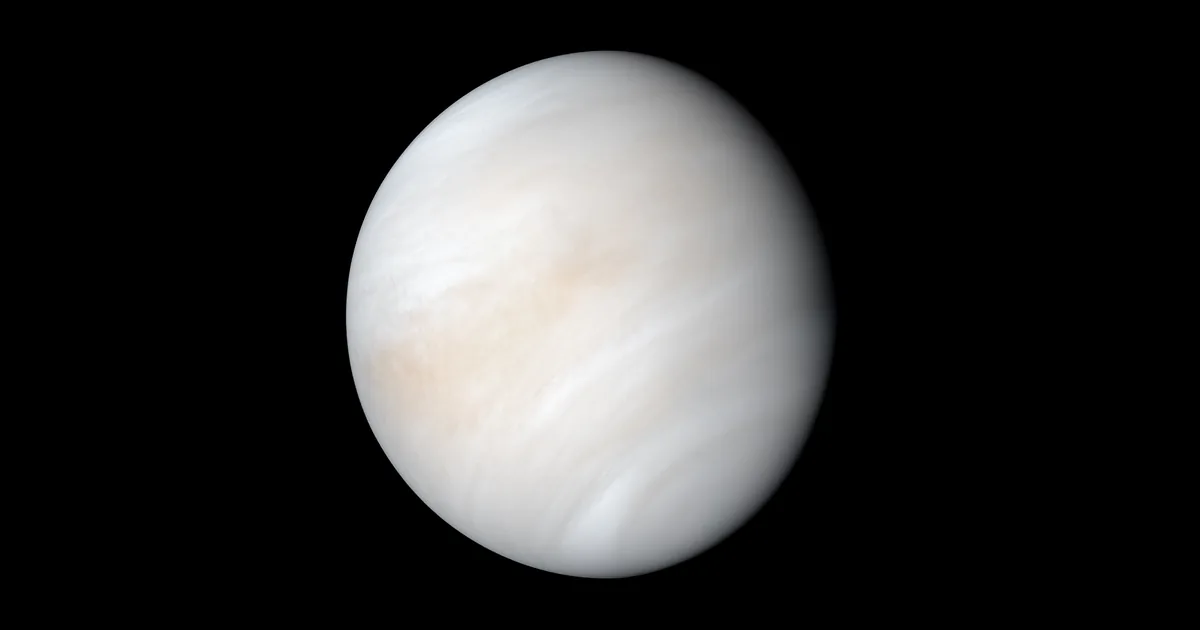
Venus is often called Earth’s “evil twin”: almost the same size, but with a surface temperature of about 464 °C and a pressure like that 900 meters below the ocean surface. These conditions pose enormous challenges for spaceflight. Even so, Venus was the first target of interplanetary missions, and its exploration is one of the most exciting chapters in space history. After a long pause, a new generation of Venus missions is now on the way.
The key facts about the planet are in our Venus profile.
The Most Important Venus Missions
| Mission | Operator | Year(s) | Type | Significance |
|---|---|---|---|---|
| Mariner 2 | NASA | 1962 | Flyby | first successful flyby of another planet |
| Venera 4 | USSR | 1967 | Atmospheric probe | first direct measurements in Venus’s atmosphere |
| Venera 7 | USSR | 1970 | Lander | first landing on another planet with data transmission |
| Venera 9 | USSR | 1975 | Orbiter and lander | first images from the surface |
| Venera 13 | USSR | 1982 | Lander | first color images, 127 minutes of operation |
| Vega 1 and 2 | USSR | 1985 | Landers and balloons | first balloons in another planet’s atmosphere |
| Magellan | NASA | 1990–1994 | Radar orbiter | mapped 98% of the surface |
| Venus Express | ESA | 2006–2014 | Orbiter | atmosphere, signs of active volcanism |
| Akatsuki | JAXA | 2015–2025 | Orbiter | weather and cloud dynamics |
Early Successes: Mariner and Venera
The race to Venus began in the 1960s. In 1962, NASA’s Mariner 2 became the first human-made object to fly successfully past another planet, revealing that Venus is extremely hot.
The Soviet Union achieved its greatest planetary successes with the Venera program. After several failures, Venera 4 returned the first measurements from inside Venus’s atmosphere in 1967. In 1970, Venera 7 made the first landing on another planet from which data were sent back to Earth; its faint signal lasted about 23 minutes. In 1975, Venera 9 transmitted the first black-and-white images of the surface, followed in 1982 by the first color images from Venera 13. That lander survived 127 minutes before heat and pressure destroyed it. In 1985, Vega 1 and 2 also released balloons that drifted through the atmosphere at about 54 km altitude for roughly two days.
The Mapping Era: Magellan
The thick clouds make optical cameras useless for viewing the surface. NASA’s Magellan therefore used radar to map about 98% of the surface between 1990 and 1994. It revealed a world of volcanoes, lava plains and tectonic structures. Its data remain valuable today: new analyses in 2023 and 2024 found changes at volcanoes such as Maat Mons and Sif Mons, strong evidence that Venus is still volcanically active.
Modern Missions: Venus Express and Akatsuki
In the 21st century, the focus shifted to the atmosphere. From 2006 to 2014, ESA’s Venus Express studied the greenhouse effect, the clouds and the interaction with the solar wind, and found hints of hot, possibly young lava flows.
Japan’s Akatsuki reached Venus only in 2015, after a failed first attempt, and then observed the fast-rotating cloud deck. Contact was lost in April 2024, and in September 2025 JAXA officially declared the mission over.
Many spacecraft bound for other destinations have also used Venus for gravity assists and observed it along the way, including Galileo, Cassini, MESSENGER, BepiColombo and, most recently, the Jupiter probe JUICE in August 2025. During its flybys, the Parker Solar Probe even imaged features on the night-side surface through the clouds.
The Future: A New Generation of Venus Missions
After decades in which Venus was overshadowed by Mars, several new missions are in preparation:
- DAVINCI (NASA): a probe will descend through the atmosphere on a parachute, measure its chemical composition and photograph the Alpha Regio highlands on the way down. Launch planned for the early 2030s.
- VERITAS (NASA): a radar orbiter to map the surface at much higher resolution than Magellan and search for active volcanism. Launch no earlier than 2031.
- EnVision (ESA): the European orbiter will study how the interior, surface and atmosphere interact. Launch 2032, arrival 2034.
- Shukrayaan (ISRO): India’s first Venus orbiter was approved in 2024 and is planned to launch in 2028.
DAVINCI and VERITAS were at times threatened by proposed US budget cuts, but Congress explicitly confirmed their funding in the 2026 budget. Exact launch dates have not yet been set.
Why Venus Matters
Exploring Venus should explain why two such similar planets as Earth and Venus evolved so differently. Did the young Venus have oceans? When and why did its greenhouse effect run out of control? The answers will also help us understand Earth’s climate and the habitability of Earth-like exoplanets.
Sources
- NASA Science: Venus
- NASA JPL: Ongoing volcanic activity in Magellan data (2024)
- JAXA: Akatsuki operation completed (2025)
- ESA: EnVision
- The Planetary Society: NASA’s 2026 budget
More about the planet: Venus facts, data and profile.