
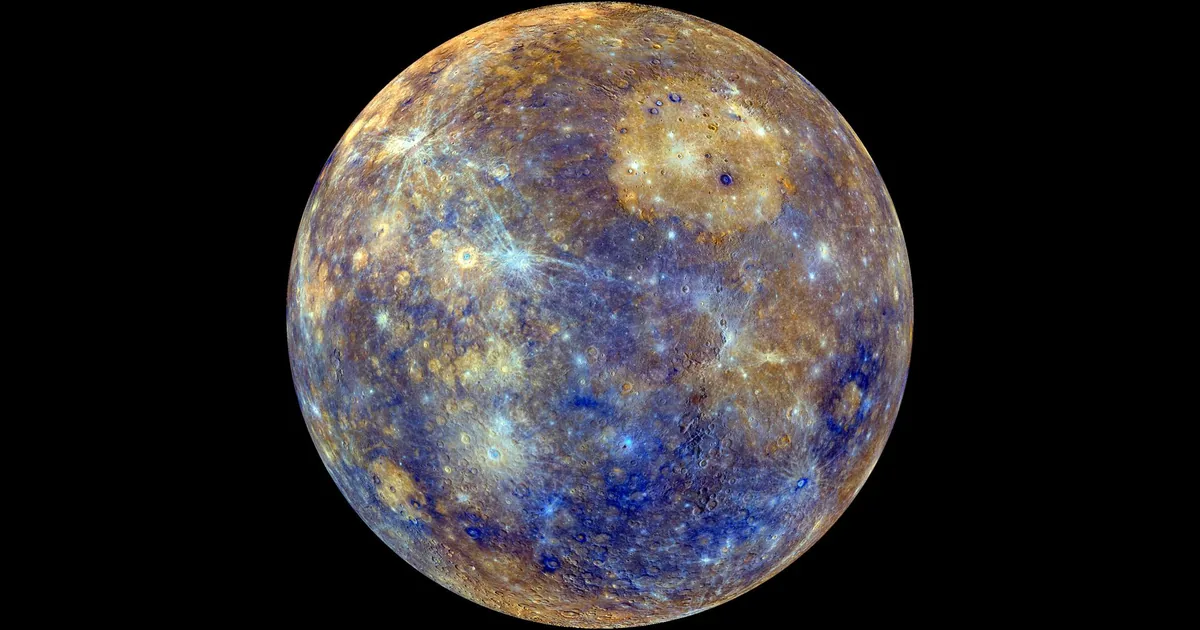
Mercury is the smallest planet and the closest to the Sun, and also one of the least explored rocky planets. Although it sometimes comes fairly close to Earth, it is one of the most difficult targets in spaceflight. Only two spacecraft have visited it so far; the third, BepiColombo, enters orbit in November 2026. This article explains why Mercury is so hard to reach, what Mariner 10 and MESSENGER discovered and what to expect from BepiColombo.
The key facts about the planet itself are in our Mercury profile.
Mercury Missions at a Glance
| Mission | Operator | Period | Type | Status |
|---|---|---|---|---|
| Mariner 10 | NASA | 1973–1975 | 3 flybys | completed |
| MESSENGER | NASA | 2004–2015 | Orbiter (from 2011) | completed, impacted Mercury in 2015 |
| BepiColombo | ESA/JAXA | since 2018 | 2 orbiters | arrival 21 November 2026 |
Why Mercury Is So Hard to Reach
A spacecraft traveling from Earth to Mercury “falls” toward the Sun and keeps speeding up. To enter orbit around the small planet, it has to shed that speed again. Doing this with propellant alone would take more energy than a flight to Pluto.
That is why every Mercury mission relies on several gravity-assist flybys of Earth, Venus and Mercury itself, each of which slows the spacecraft down a little. On top of that come the extreme heat and radiation so close to the Sun, against which heat shields and special coatings must protect the instruments.
Mariner 10 (1973–1975): The Pioneer
NASA’s Mariner 10 launched on 3 November 1973 and was the first spacecraft to use a gravity assist, at Venus, to change course toward its next target. It was therefore also the first spacecraft to visit two planets.
- Three flybys: Mariner 10 flew past Mercury in March and September 1974 and in March 1975, without entering orbit.
- Mapping: because the same side was lit during all three flybys, it could photograph only about 45% of the surface.
- Magnetic surprise: Mariner 10 discovered a weak global magnetic field. This was unexpected, as the core of such a small planet was thought to have solidified long ago.
MESSENGER (2004–2015): The First Orbiter
Almost 30 years passed before the return. NASA’s MESSENGER (MErcury Surface, Space ENvironment, GEochemistry, and Ranging) launched in August 2004. After one flyby of Earth, two of Venus and three of Mercury, it became the first spacecraft to enter Mercury orbit in March 2011.
- Complete map: MESSENGER mapped the entire surface for the first time.
- Water ice: its most spectacular discovery was water ice in craters near the poles whose floors never see sunlight, on a planet with daytime temperatures above 400 °C.
- Volcanism and “hollows”: vast lava plains show early volcanism, and puzzling depressions called “hollows” suggest that volatile substances are evaporating from the rock.
- Offset magnetic field: the magnetic field is shifted noticeably toward the north.
After more than 4,000 orbits its propellant was exhausted. On 30 April 2015, MESSENGER struck the surface at about 14,000 km/h, leaving a new crater.
BepiColombo: The European-Japanese Mission
BepiColombo is the most complex Mercury mission yet, a joint project of the European Space Agency ESA and the Japan Aerospace Exploration Agency JAXA. It launched on 20 October 2018 and consists of three parts traveling together:
- MPO (Mercury Planetary Orbiter, ESA): maps the surface and topography and studies the planet’s composition and interior.
- Mio (Mercury Magnetospheric Orbiter, JAXA): studies the magnetic field, magnetosphere and exosphere.
- MTM (Mercury Transfer Module): the propulsion module with ion engines, which is jettisoned after arrival.
The Long Journey
On its way, BepiColombo made nine flybys: one of Earth, two of Venus and six of Mercury, the last in January 2025. In April 2024, a problem with the power supply to the ion engines meant they could no longer run at full thrust. The trajectory was adjusted, and the arrival originally planned for December 2025 slipped by almost a year.
Current Status and Timeline
- 21 November 2026: orbit insertion around Mercury.
- 9–10 December 2026: separation of the two orbiters MPO and Mio, which then head for their own orbits.
- April 2027: start of the main science phase.
Among other things, BepiColombo is to determine how large the liquid part of the iron core is, why Mercury is so dense, how its magnetic field is generated and how much water ice is stored in the polar craters. With two spacecraft measuring at the same time, processes in the magnetosphere can be observed at two locations simultaneously for the first time.
A Key to Understanding Rocky Planets
Mercury is an extreme case among rocky planets: tiny, dense and right next to the Sun. Studying it helps us understand how planets form close to a star, a question that also matters for many hot exoplanets. MESSENGER fundamentally changed our picture of Mercury, and BepiColombo will sharpen it considerably from 2027 onward.
Sources
- ESA: BepiColombo’s arrival at Mercury
- NASA: MESSENGER
- Johns Hopkins APL: MESSENGER mission
- NASA: Mariner 10
More about the planet: Mercury facts, data and profile.