
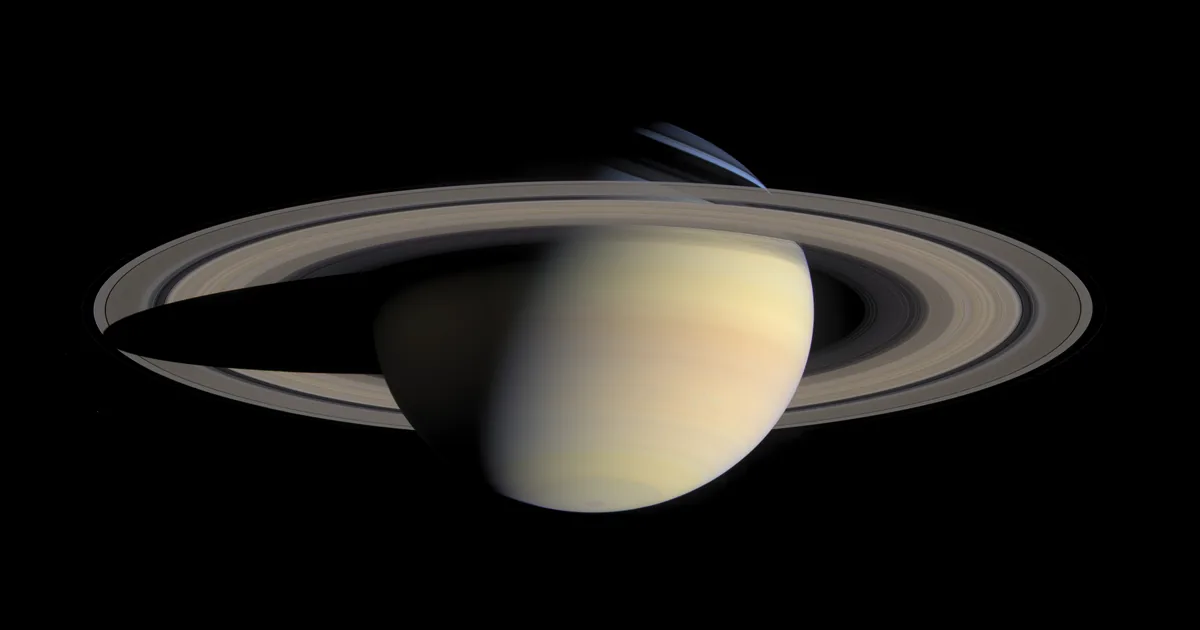
The Cassini-Huygens mission is one of the most successful projects in the history of planetary science. For 13 years, the Cassini orbiter studied Saturn, its rings and its moons, while the Huygens probe landed on Saturn’s largest moon, Titan, in 2005. Their discoveries, from the water plumes of Enceladus to the methane lakes of Titan, fundamentally changed the search for habitable environments in the solar system.
Cassini-Huygens at a Glance
| Property | Value |
|---|---|
| Operators | NASA, ESA and the Italian Space Agency ASI |
| Launch | 15 October 1997 on a Titan IVB rocket |
| Gravity assists | Venus (1998 and 1999), Earth (1999), Jupiter (2000) |
| Arrival at Saturn | 1 July 2004 |
| Huygens landing on Titan | 14 January 2005 |
| Orbits of Saturn | 294, plus 127 flybys of Titan and 23 of Enceladus |
| Power | three radioisotope generators |
| End of mission | 15 September 2017, deliberate plunge into Saturn’s atmosphere |
The Mission at a Glance
Cassini-Huygens was a joint project of NASA, the European Space Agency ESA and the Italian Space Agency ASI. NASA provided the Cassini orbiter, named after astronomer Giovanni Domenico Cassini, who among other things discovered the gap in Saturn’s rings that bears his name. ESA built the Huygens probe, named after Christiaan Huygens, who discovered Titan in 1655.
After launching in October 1997, the spacecraft gained speed during flybys of Venus, Earth and Jupiter and reached Saturn in July 2004. From launch to its end in 2017, the mission lasted 20 years.
Cassini’s Key Discoveries
Enceladus: An Ocean Beneath the Ice
Among the biggest surprises were the plumes of water vapor and ice particles discovered at the south pole of the small moon Enceladus in 2005. Cassini flew straight through them several times, detecting salts, organic molecules and molecular hydrogen. A global, salty ocean beneath the crust is now considered certain, possibly with hydrothermal vents on the seafloor. A 2023 analysis of Cassini data also found phosphate, a key building block of life. Enceladus is therefore one of the most promising places to search for life in the solar system.
Titan: Lakes of Methane and Ethane
With its radar, Cassini looked through Titan’s thick haze and discovered lakes and seas, mostly near the north pole. They are made not of water but of liquid methane and ethane; the largest, Kraken Mare and Ligeia Mare, are bigger than some inland seas on Earth. Besides Earth, Titan is the only known body with stable liquids on its surface, and it has a methane cycle with clouds, rain and rivers similar to Earth’s water cycle.
The Ring System
Cassini returned the most detailed images of Saturn’s rings: wave patterns excited by moons, “propeller” structures around embedded small bodies and tiny shepherd moons that keep narrow rings such as the F ring in shape. The spacecraft discovered several new moons. Measurements of the ring mass during the final phase suggest that the rings may be relatively young, a question still debated today.
Atmosphere and Storms
Cassini observed the north polar hexagon up close and in 2010/2011 followed a huge storm, the “Great White Spot”, which wrapped around the entire planet within a few months. Because the mission lasted almost half a Saturn year, seasonal changes could also be tracked.
The Huygens Landing on Titan
Huygens separated from the orbiter on 25 December 2004. On 14 January 2005 it entered Titan’s thick orange atmosphere and descended under parachutes for about two and a half hours. On the way down it photographed hills and branching river channels leading into a dark plain.
Huygens landed on damp, sand-like ground strewn with rounded chunks of water ice resembling river pebbles, and then transmitted data from the surface for about 72 minutes. It was the first landing on a body in the outer solar system and remains the only one to this day.
The End of Cassini: The “Grand Finale”
After 13 years in the Saturn system, its propellant was running low. To prevent the spacecraft from one day crashing uncontrolled onto Enceladus or Titan and contaminating them with microbes from Earth, the mission was ended deliberately. From April 2017, Cassini flew 22 times through the previously unexplored gap between the planet and its innermost rings. On 15 September 2017 it plunged into Saturn’s atmosphere, sending data until the very end.
Legacy and Successors
Cassini’s vast data set is still being analyzed and continues to yield new findings. The next mission to the Saturn system has already been approved: NASA’s Dragonfly is to launch in July 2028 and, from 2034, fly as a rotorcraft across the surface of Titan. The earlier flybys of Pioneer 11 and the Voyager probes are covered in the article on the Voyager mission.
Sources
More about the planet: Saturn facts, data and profile.