
In January 2025, C/2024 G3 (ATLAS) passed extremely close to the Sun and became very bright. For observers in the northern hemisphere, though, it stayed low in the twilight almost the whole time. From Alexandria, at about 31° north, there were only a few chances to catch it just above the horizon. My images were taken with a DSLR and telephoto lens on a fixed tripod without tracking.
Fact Sheet: C/2024 G3 (ATLAS)
- Discovery: On 5 April 2024 by the ATLAS survey with a 0.5 m telescope at Río Hurtado, Chile.
- Perihelion: On 13 January 2025 at only about 0.09 AU (about 13 million km) from the Sun, less than a quarter of Mercury’s distance.
- Peak brightness: About −3.8 mag on the day of perihelion, only about 5° from the Sun. From 11 to 15 January the comet was visible in the coronagraph of the SOHO spacecraft.
- Break-up: Around perihelion there were already signs that the nucleus was fragmenting. By about 19 January the bright head had disappeared and only a long tail remained, much like comet C/2011 W3 (Lovejoy).
- Visibility after perihelion: Mainly from the southern hemisphere, where its tail was an impressive sight in the evening twilight.
- Orbit: Its orbital period before this passage was about 180,000 years. After perihelion it is about 600,000 years, according to JPL orbit calculations.
Mornings Before Perihelion
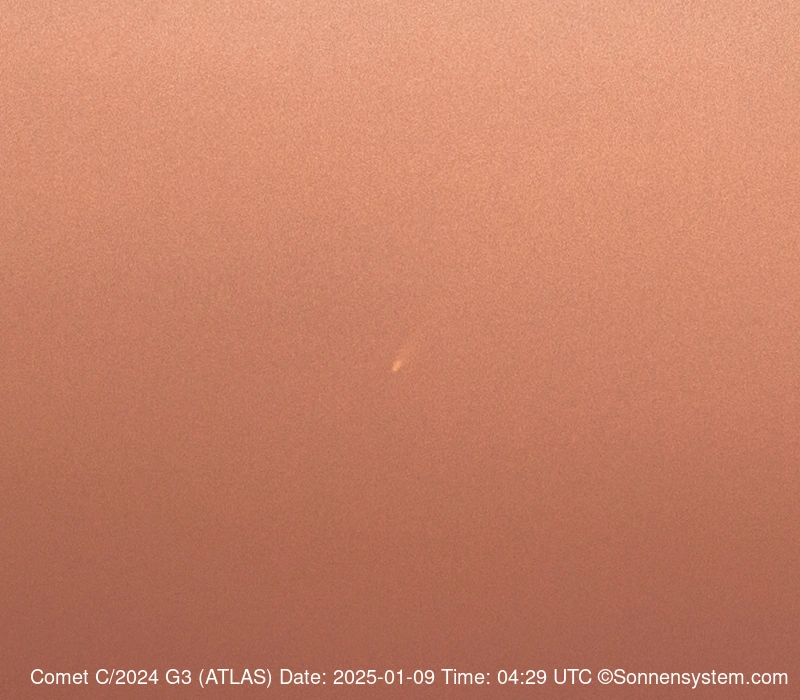
In the last days before perihelion I tried to find the comet low in the morning twilight, 30 to 40 minutes before sunrise. It was only 1 to 3° above the horizon, in an already bright sky. On 9 January it was visible with a short tail.
An Evening One Day After Perihelion
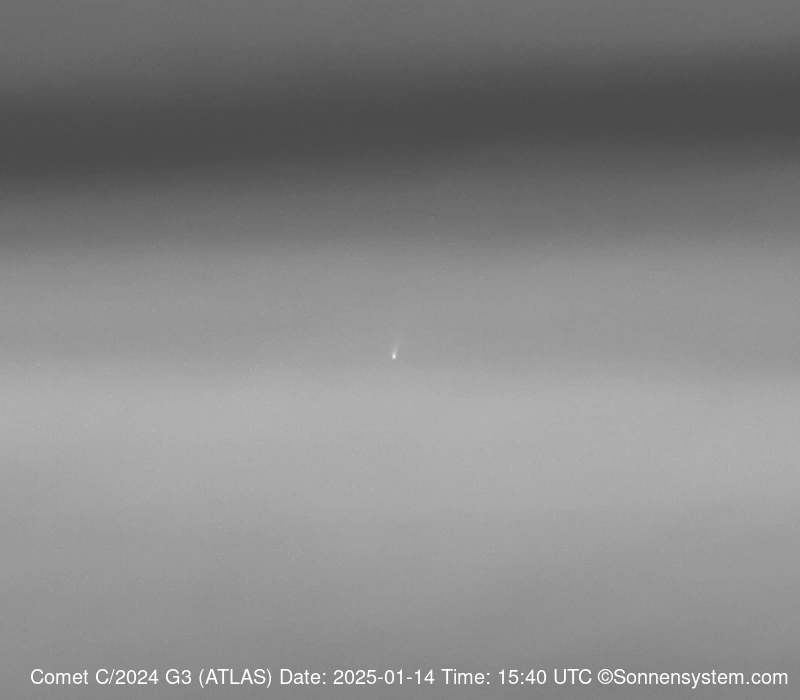
From 14 January the comet stood low above the western horizon after sunset. That evening, about 20 minutes after sunset, I managed one image through a gap in the clouds, at about 2° above the horizon. According to other observers’ brightness estimates, the comet was about −2.5 mag at that time.
What Happened Next
After that the comet was out of reach from Alexandria. In the southern hemisphere it developed a long tail while its nucleus broke apart. A few months earlier I had much better conditions with C/2023 A3 (Tsuchinshan-ATLAS). More about comets is on my page about comets.