Neptune: The Blue Giant on the Edge of the Solar System
Neptune is the eighth and outermost planet of the solar system, about 30 times farther from the Sun than Earth. Its discovery was a triumph of celestial mechanics: from irregularities in the orbit of Uranus, Urbain Le Verrier calculated the position of an unknown planet, and Johann Gottfried Galle found it in 1846 almost exactly where predicted. Like Uranus, Neptune is an ice giant, with a mantle of water, ammonia and methane around a rocky core.
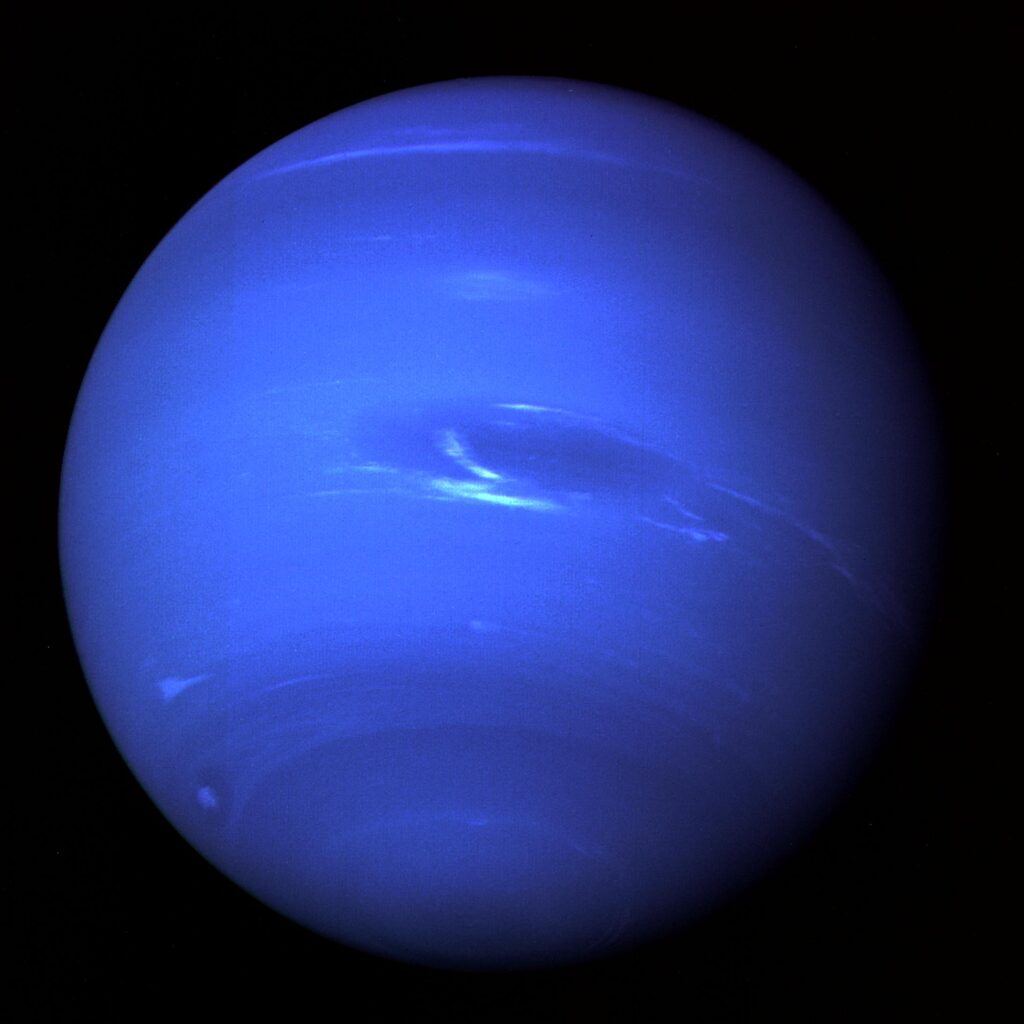
Although Neptune receives only a tiny fraction of the sunlight that reaches Earth, it is a world of extreme weather: its atmosphere has the fastest winds in the solar system, reaching up to 2,100 km/h. In 1989, Voyager 2 observed the “Great Dark Spot”, a storm roughly the size of Earth. Neptune has 16 known moons. The largest, Triton, orbits it backwards and is probably a captured object from the Kuiper Belt.
Neptune at a Glance
| Property | Value |
|---|---|
| Type | Ice giant |
| Diameter (equatorial) | 49,528 km (3.9 × Earth) |
| Mass | 1.02 × 10²⁶ kg (17 Earth masses) |
| Mean density | 1.64 g/cm³ (densest giant planet) |
| Gravity (1-bar level) | 11.2 m/s² (1.14 g) |
| Mean distance from the Sun | 4.50 billion km (30.1 AU) |
| Closest / farthest from the Sun | 4.47 / 4.56 billion km |
| Orbital eccentricity | 0.010 |
| Orbital period | approx. 165 years |
| Rotation period | 16 h 6 min |
| Axial tilt | 28.3° |
| Temperature | approx. −200 °C (1-bar level), minimum approx. −218 °C |
| Atmosphere | approx. 80% hydrogen, 19% helium, 1.5% methane |
| Magnetic field | Tilted 47° from the rotation axis and offset from the planet’s center |
| Moons | 16 |
| Rings | 5 main rings (Galle, Le Verrier, Lassell, Arago, Adams) of dark dust |
| Spacecraft | Voyager 2 (flyby 1989); no other mission so far |
Discovery
After Uranus was discovered, astronomers noticed that it strayed from its calculated orbit. Urbain Le Verrier in Paris and, independently, John Couch Adams in England concluded that another, unknown planet must exist. Using Le Verrier’s calculations, Johann Gottfried Galle at the Berlin Observatory found Neptune on 23 September 1846, less than one degree from the predicted position. Galileo Galilei had already seen Neptune through his telescope in 1612/1613 but took it for a fixed star. Neptune completed its first full orbit since its discovery in 2011.
Internal Structure and Internal Heat
Neptune’s structure resembles that of Uranus: beneath an envelope of hydrogen, helium and methane lies a dense, hot mantle of water, ammonia and methane, with a core of rock and ice at the center. At 1.64 g/cm³, Neptune is the densest of the four giant planets. Unlike Uranus, it has a strong internal heat source: it radiates about 2.6 times as much energy as it receives from the distant Sun. This heat probably drives its active weather.
Atmosphere, Winds and Storms
Neptune’s atmosphere has the fastest winds in the solar system, reaching up to 2,100 km/h. In 1989, Voyager 2 discovered the Great Dark Spot in the southern hemisphere, a high-pressure vortex roughly the size of Earth, accompanied by bright methane-ice clouds. When the Hubble Space Telescope looked in 1994, the spot had vanished. Since then, Hubble has repeatedly seen new dark spots form and fade, and in 2023 the Very Large Telescope made the first observation of such a spot from the ground.
Neptune’s bright clouds almost completely disappeared between 2019 and 2023. An analysis of nearly 30 years of observations shows that their abundance follows the Sun’s eleven-year activity cycle, despite Neptune’s great distance.
Color: Bluer Than Uranus?
In the famous Voyager images, Neptune appears deep blue and much darker than Uranus. A 2024 reanalysis showed, however, that those images had been contrast-enhanced at the time. In reality, both ice giants have a very similar pale greenish-blue color; Neptune is only slightly bluer because its haze layer is thinner. As on Uranus, the color comes from methane absorbing red light.
Rings and Moons
Neptune has five narrow main rings of dark dust, named after astronomers connected with its discovery. The outer Adams ring contains striking clumps, the ring arcs Liberté, Égalité, Fraternité and Courage. In 2022, the James Webb Space Telescope imaged the rings more clearly than at any time since Voyager 2.
Of its 16 known moons, the two most recent were announced in 2024.
- Triton: at 2,707 km, by far the largest moon of Neptune and the only large moon in the solar system on a retrograde orbit. It is probably a captured Kuiper Belt object, with a thin nitrogen atmosphere, nitrogen geysers and, at around −235 °C, one of the coldest surfaces in the solar system. Tidal forces are slowly pulling it inward.
- Nereid: orbits Neptune on an extremely elongated path.
- Proteus: about 420 km across, the second-largest moon, dark and irregularly shaped.
Magnetic Field
As with Uranus, Neptune’s magnetic field is strongly tilted from the rotation axis, here by 47°, and noticeably offset from the planet’s center. Its magnetic moment is about 27 times that of Earth, yet at the cloud tops the field is weaker than Earth’s. Like Uranus’s, it is probably generated in a conducting layer of the fluid mantle rather than in the core.
Observing Neptune
At around magnitude 7.8, Neptune is not visible to the naked eye. Binoculars or a small telescope and a finder chart are enough to find it as an inconspicuous point of light. In 2026 it lies in the constellation Pisces, just under 9° west of Saturn, which can serve as a signpost. Only at high magnification does a telescope show a tiny bluish disk just over 2 arcseconds across.
- 2026 opposition: 26 September 2026, magnitude +7.8.
- After that: 28 September 2027 and 30 September 2028.
Exploration of Neptune
Only Voyager 2 has visited Neptune so far. In August 1989, it flew less than 5,000 km above the cloud tops, photographed the Great Dark Spot, discovered six new moons, confirmed the ring system and found geysers on Triton. More in the article on the Voyager mission. Since then, Hubble, the James Webb Space Telescope and large ground-based telescopes have been the main observers of the planet. No dedicated Neptune mission is currently approved.