
Saturn: The Lord of the Rings and Second Largest Planet
Overview and Key Characteristics
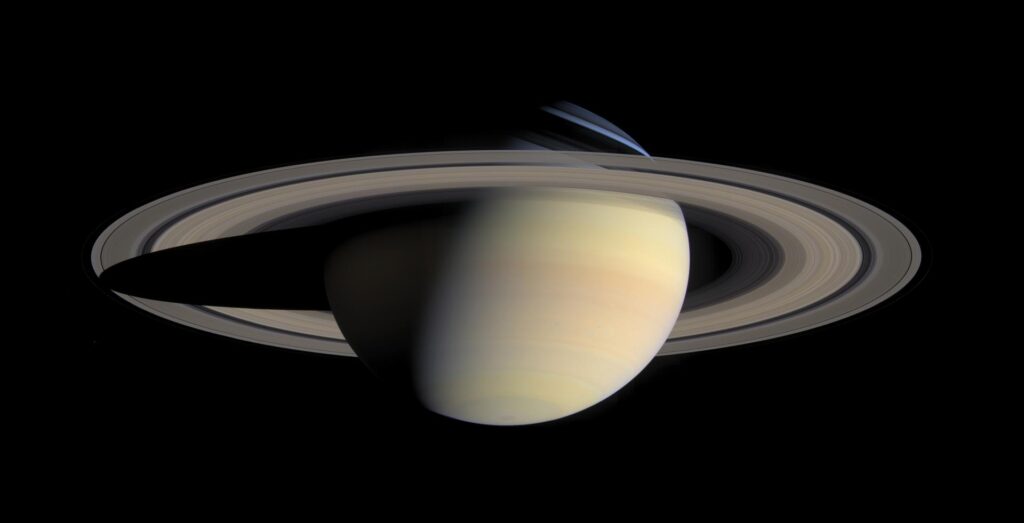
Saturn, the sixth planet from the Sun, is widely regarded as the most visually stunning object in the solar system. As the second-largest planet after Jupiter, this Gas Giant is composed primarily of hydrogen and helium. One of its most fascinating physical properties is its incredibly low density—Saturn is actually less dense than water, meaning it would technically float in a vast enough ocean. Beneath its hazy, banded atmosphere lies a hot interior with a core of rock and ice, surrounded by a layer of liquid metallic hydrogen that generates the planet’s powerful magnetic field.
The planet is best known for its spectacular ring system, an intricate halo of seven main rings and thousands of smaller ringlets. These structures are made of billions of individual pieces of water ice and rock, ranging in size from microscopic grains to mountains. This complex geometry is held in place by “shepherd moons” that clear gaps within the rings. Beyond its golden appearance, Saturn is a world of extreme meteorology, featuring supersonic winds that can reach 1,800 km/h (1,100 mph) and a bizarre, permanent hexagonal storm at its North Pole. With a vast family of over 140 moons, Saturn hosts some of the most scientifically intriguing worlds in the system, such as Titan, with its liquid methane lakes, and Enceladus, which hides a subsurface ocean capable of supporting life. Much of our modern understanding of this giant comes from the historic Cassini-Huygens mission, which spent 13 years orbiting the planet.
Planetary Data Table
| Characteristic | Value |
|---|---|
| Diameter | 120,536 km |
| Mass | 5.683 x 10^26kg (approx. 95 Earth masses) |
| Mean Distance from Sun | 1.429 billion km (approx. 9.58 AU) |
| Orbital Period | 29.45 years |
| Rotational Period (Day) | 10 hours 42 minutes |
| Surface Temperature | -139 °C |
| Atmosphere | 96 % Hydrogen, 3 % Helium |
| Number of Moons | 146 (known) |
| Ring System | 7 main rings, extending over 282,000 km |
| Magnetic Field | approx. 10 times stronger than Earth’s magnetic field |
The Ring System
Saturn’s most distinguishing feature is its complex ring system . Stretching over approximately 282,000 kilometers, the rings consist of billions of particles made of water ice and rock, ranging in size from dust grains to small boulders. The rings are organized into seven main regions (A, B, C, D, E, F, and G) and are surprisingly thin, sometimes only tens of meters thick.
Atmosphere and Storms
Saturn’s atmosphere is dominated by fast winds, reaching speeds up to 1,800 km/h. A mysterious and permanent feature is the Hexagon storm at the North Pole, a unique cloud formation shaped like a hexagon with a diameter of about 30,000 kilometers. The planet also experiences massive, periodic tempests known as the Great White Spot.
Saturn’s Moons
Saturn has a massive moon system. Among the 146 known moons, two stand out for their potential habitability:
- Titan: Saturn’s largest moon and the second largest in the solar system. It is the only moon with a dense atmosphere and the only object besides Earth known to have stable liquid bodies (methane/ethane oceans) on its surface.
- Enceladus: A smaller, icy moon famous for shooting plumes of water ice and vapor into space. It is believed to harbor a global subsurface ocean of liquid water, making it a prime target in the search for extraterrestrial life.
Magnetosphere and Exploration
Saturn’s powerful magnetic field is approximately 580 times stronger than Earth’s. This field creates an extensive magnetosphere that protects the planet and its moons from the solar wind, resulting in spectacular auroral displays.
The most significant mission to Saturn was Cassini-Huygens, which orbited the planet from 2004 to 2017, providing an unprecedented amount of data about Saturn, the rings, atmosphere, and moons, including deploying the Huygens probe onto Titan’s surface. Saturn’s gravity is crucial for the stabilization of the solar system, influencing the orbits of numerous smaller bodies.