
Sunspots are the most visible manifestation of the Sun’s magnetic activity as darker, cooler regions on the solar surface that play a critical role in our understanding of the Sun’s variability and its impact on Earth. These fascinating phenomena are linked to the Solar Sunspot Cycle, an approximately 11-year long cycle.
This comprehensive article covers the physics of sunspots, the dynamics of the current Solar Cycle 25, and the profound effects solar activity has on our technology and our planet’s near-space environment, known as space weather. For the latest up-to-date data on the daily activity of our star, you can visit our Solar Data Archive.
What Exactly Are Sunspots?
Sunspots are regions where extremely strong magnetic fields rise from the Sun’s interior, piercing the visible surface, the photosphere.
- Temperature Differential: While the surrounding photosphere maintains a temperature of about 5,500°C, the intense magnetic fields within a sunspot effectively inhibit the convection of hot plasma from below. This cooling process lowers the sunspot’s temperature to roughly 4,000°C.
- Appearance: This significant temperature drop makes the sunspot appear dark when contrasted against the brilliant background, though it is still incredibly hot by terrestrial standards.
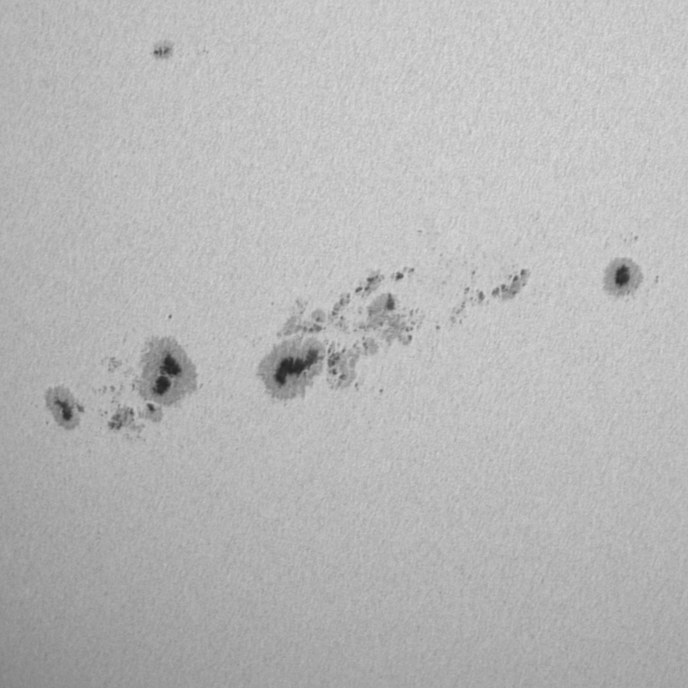
- Structure and Scale: A large sunspot typically consists of a dark central area, the umbra (full shadow), surrounded by a lighter ring of filaments, the penumbra (partial shadow). Sunspots often appear in groups, collectively known as active regions, and can grow to be many times larger than the Earth.
The 11-Year Solar Sunspot Cycle
The Solar Cycle is the fundamental driver of all solar activity, averaging about 11 years in duration. It tracks the rise and fall of the number of sunspots and the accompanying magnetic complexity of the Sun.
Key Phases of the Cycle:
| Phase | Description | Activity Profile |
| Solar Minimum | Marks the beginning of a new cycle. The Sun is magnetically quiescent with minimal sunspot presence. Days with a spotless Sun are common. | Low activity, infrequent coronal mass ejections (CMEs). |
| Solar Maximum | Occurring about five to six years after the minimum, this phase represents the cycle’s peak. The Sun is highly active, with a maximum number of sunspots and complex magnetic fields. | High activity, frequent solar flares and CMEs. |
The 22-Year Magnetic Cycle
It is crucial to note that the Sun’s magnetic cycle is actually 22 years long. At the end of each 11-year sunspot cycle, the Sun’s magnetic field reverses its polarity (North becomes South and vice versa). Sunspots appearing in the subsequent cycle exhibit this reversed polarity, thus completing the full magnetic cycle over two sunspot cycles.
Current Status: Cycle 25
We are currently in Solar Cycle 25, which began at the solar minimum in December 2019. It reached its maximum in October 2024, with a smoothed sunspot number of about 161. That made Cycle 25 considerably stronger than predicted: in 2019 the NOAA/NASA prediction panel had expected a weak peak of about 115 in mid-2025. It was also stronger than Cycle 24, although it falls short of the great cycles of the mid-20th century.
Since late 2024 the Sun has been in the declining phase. The number of sunspots is slowly dropping, but this phase is known for occasional very strong eruptions. Examples are the huge sunspot complex AR 4294-4296-4298 in December 2025 (pictured above) and the region AR4366 with its X8.1 flare in February 2026. The next minimum, and with it the start of Cycle 26, is expected around 2030.
Cycle 25 in Numbers
| Event | Date | Details |
|---|---|---|
| Minimum (start of Cycle 25) | December 2019 | Transition from Cycle 24 to 25 |
| Strongest geomagnetic storm | 10–11 May 2024 | G5 (extreme), auroras as far south as southern Europe and Mexico |
| Strongest flare | 3 October 2024 | X9.0 from region AR3842 |
| Maximum | October 2024 | Smoothed sunspot number approx. 161 |
| Next minimum | around 2030 (forecast) | Start of Cycle 26 |
Terrestrial Impacts of the Solar Cycle
The heightened magnetic energy released around a solar maximum has tangible consequences for Earth and its technological systems.
- Space Weather and Geomagnetic Storms: Frequent and powerful solar flares and CMEs during the maximum send bursts of energetic particles toward Earth. When these interact with our planet’s magnetosphere, they can trigger geomagnetic storms. These storms pose a risk to:
- Communication & Navigation: Disturbing GPS, satellite communications, and high-frequency radio signals.
- Power Grids: Inducing currents in long transmission lines, potentially causing blackouts or damaging transformers.
- Satellites: Increasing atmospheric drag and causing radiation damage to onboard electronics.
- Auroras (Polar Lights): The most visually stunning effect is the creation of the Aurora Borealis (Northern Lights) and Aurora Australis (Southern Lights). During geomagnetic storms, solar particles penetrate the atmosphere and collide with atmospheric gases, causing them to glow. These lights are more frequent and visible at lower latitudes during solar maximum periods, as in May 2024.
- Atmospheric Effects: Increased ultraviolet (UV) radiation during the maximum can heat and expand Earth’s upper atmosphere, slightly influencing atmospheric circulation and increasing the drag on low-orbiting satellites.
Sunspots in Historical Context
The study of sunspots has been central to astronomy, fundamentally altering our view of the Sun as an unchangeable body.
- Early Telescopic Observations: While ancient Chinese records document occasional sunspot sightings, it was 17th-century European astronomers, most notably Galileo Galilei, who first systematically observed them using telescopes. Their observations proved that sunspots were features on the Sun’s surface and demonstrated that the Sun rotates.
- The Maunder Minimum: A critical period in solar history was the Maunder Minimum (c. 1645–1715), a decades-long interval when virtually no sunspots were observed. This event coincided with the “Little Ice Age,” a period of unusually cold temperatures in parts of the Northern Hemisphere, providing strong historical evidence that solar activity plays a modulating role in Earth’s climate, though it is not the primary driver of modern climate change.
The Scientific Imperative: Monitoring Sunspots
Today, sunspots are a primary focus of Heliophysics, providing crucial data for operational and theoretical science.
- Magnetohydrodynamics (MHD): Observing the formation, evolution, and decay of sunspots provides key data for understanding the complex field dynamics and the solar dynamo, the mechanism that generates the Sun’s magnetic field.
- Space Weather Forecasting: Real-time sunspot data, particularly the magnetic complexity of active regions, is the most important input for space weather prediction models. This forecasting is essential for government agencies and industries to protect critical infrastructure.
- Advanced Observatories: Modern instruments, such as the Solar Dynamics Observatory (SDO) and the ground-based Daniel K. Inouye Solar Telescope (DKIST), provide continuous, high-resolution imagery and spectrographic data, allowing scientists to monitor the Sun’s behavior in unprecedented detail.
Sunspots as Solar Activity Indicators
Sunspots and the Solar Cycle are the fundamental indicators of the Sun’s inherent magnetism and energy output. They are not merely objects of scientific curiosity; they are the key to understanding the dynamic, evolving nature of our star and predicting phenomena that directly affect life and technology on Earth.
As Solar Cycle 25 winds down towards its minimum around 2030 and Cycle 26 approaches, the continued monitoring and study of sunspots remain vital for ensuring the resilience of our space-based and terrestrial technological infrastructure in the face of unpredictable solar variability.