

The Sun is the center of our planetary system. It provides light, heat, and energy, drives space weather, and has fascinated astronomers for millennia. But what lies beneath that glaring surface? The layers of the Sun are highly complex and resemble a gigantic thermonuclear reactor, divided into distinct, sharply defined layers.
In this article, we take a detailed look at the inner structure, the dynamic atmosphere, and the latest scientific discoveries regarding our home star.
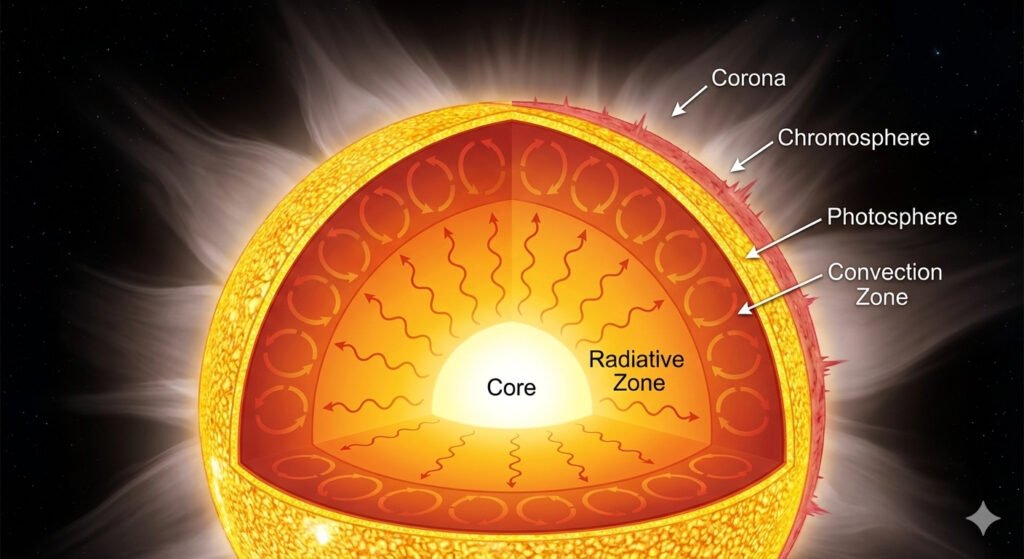
The Inner Layers of the Sun: Where Energy is Produced
The inner structure of the Sun cannot be observed directly because the extremely dense plasma blocks any sight. Therefore, astronomers use helio-seismology – the study of sound waves traveling through the star’s interior – to map its layers. The Sun’s interior is divided into three main regions:
1. The Core
The core extends from the center to about 20 to 25% of the solar radius. Extreme conditions prevail here: the temperature is around 15 million °C (27 million °F), and the pressure is billions of times higher than on Earth. These conditions are absolutely necessary for nuclear fusion to occur.
In the core, hydrogen nuclei (protons) fuse to form helium. This process, known as the proton-proton chain, is the primary energy source of the Sun. You can see the highly simplified overall reaction here:
Through mass defect (according to Einstein’s famous formula E=mc²), pure energy is released in the form of gamma radiation and neutrinos. In this way, the Sun converts over 4 million tons of matter into energy every single second.
2. The Radiative Zone
Directly adjacent to the core is the radiative zone, which extends to about 70% of the solar radius. In this layer, the solar plasma is so dense that the gamma photons generated in the core cannot simply fly outward.
Instead, they undergo a “random walk.” A photon collides countless times with electrons and ions, gets absorbed, and is re-emitted in a random direction. It can take anywhere between 10,000 and 170,000 years for a single photon to traverse this zone. During this process, the plasma gradually cools down from around 7 million °C at the inner boundary to about 2 million °C at the outer edge.
3. The Convection Zone
The outermost layer of the inner solar structure is the convection zone. Here, the plasma is cool enough (below 2 million °C) for heavy atoms to capture electrons, making the material more opaque to radiation.
Thermal energy can no longer be transported efficiently by radiation. Instead, convection takes over – much like boiling water in a pot. Hot plasma rises in giant bubbles to the surface, cools down there, and sinks back into the depths at the edges of the convection cells. This constant churning takes about a month on average and generates massive plasma currents that are crucial to the solar magnetic field.
The Solar Atmosphere: The Outer Layers of the Sun
What we see from Earth is not a solid surface of the Sun – because a ball of gas doesn’t have one – but rather the beginning of the solar atmosphere. This, in turn, is divided into three highly dynamic layers.
The Photosphere (The “Sphere of Light”)
The photosphere is the visible surface of the Sun and marks the boundary where the solar plasma becomes transparent. It is only about 400 kilometers thick. Here, the temperature drops to its minimum in the entire structure of the Sun: “only” about 5,500 °C (10,000 °F).
The convection currents from the depths are visible here as a grainy pattern called granulation. Each of these “granules” is about the size of Europe and exists for only 10 to 20 minutes. Sunspots also form in the photosphere (like the highly active region AR4366 in February 2026). These spots are cooler (approx. 3,500 to 4,500 °C) and therefore appear dark.
Tip for amateur astronomers: If you want to follow the daily evolution of the photosphere and sunspots, take a look at our constantly growing Solar Data Archive. There, we photographically document current solar activity on a daily basis.
The Chromosphere (The “Sphere of Color”)
Above the photosphere lies the chromosphere, a layer about 2,000 kilometers thick. It owes its name to the characteristic red glow that becomes visible during total solar eclipses. This glow comes from the H-alpha emission of hydrogen.
Surprisingly, the temperature rises again here, from 4,500 °C up to 20,000 °C. The chromosphere is highly structured and riddled with spicules – giant, needle-like plasma jets that shoot into the upper atmosphere at speeds of up to 100 km/s.
The Corona (The “Crown”)
The outermost layer in the structure of the Sun is the corona. It consists of extremely tenuous plasma that extends millions of kilometers into space, seamlessly transitioning into the solar wind.
The corona holds one of the greatest mysteries in modern astrophysics: the coronal heating problem. Although it is much further from the energy-producing core than the photosphere, temperatures in the corona suddenly spike to 1 to 3 million °C (and even up to 20 million °C during flares).
Magnetism: The Engine of Solar Activity
The structure of the Sun would not be completely understood without its magnetic field. Due to the rotation of the electrically conducting plasma (the equator rotates faster than the poles), a dynamo effect is created at the tachocline – the boundary layer between the radiative and convection zones.
This magnetic field breaks through the photosphere in many places and drives space weather. Magnetic energy discharges in the form of:
- Solar Flares: Sudden bursts of radiation.
- Coronal Mass Ejections (CMEs): Billions of tons of plasma hurled into space, which can cause auroras on Earth.
Latest Discoveries from Research
Our understanding of the structure of the Sun is evolving rapidly. A enormous contribution to this is being made by NASA’s Parker Solar Probe. This spacecraft dives deeper into the solar atmosphere than any human-made object before it.
It has crossed the Alfvén boundary – the point where the solar wind becomes fast enough to break free from the Sun’s magnetic field. The probe’s data suggest that magnetic “switchbacks” (S-shaped reversals of magnetic field lines) play a key role in heating the corona. (You can learn more about the mission on our dedicated Parker Solar Probe page).
Furthermore, modern solar telescopes like the Inouye Solar Telescope in Hawaii are providing unprecedented, high-resolution images of convection cells and magnetic flux tubes in the photosphere, confirming our models of plasma dynamics.
The Sun – A Perfectly Balanced System
The structure of the Sun is a cosmic masterpiece of hydrostatic equilibrium – the outward force of nuclear fusion perfectly balances the inward force of gravity. From the bubbling fusion reactor in the core through the sluggish radiative zone to the extremely hot, magnetic atmosphere, all layers interlock seamlessly.
A precise knowledge of this structure not only helps us to better understand stars throughout the rest of the universe, but is also vital for predicting the space weather that impacts our modern, technology-based society on Earth.