

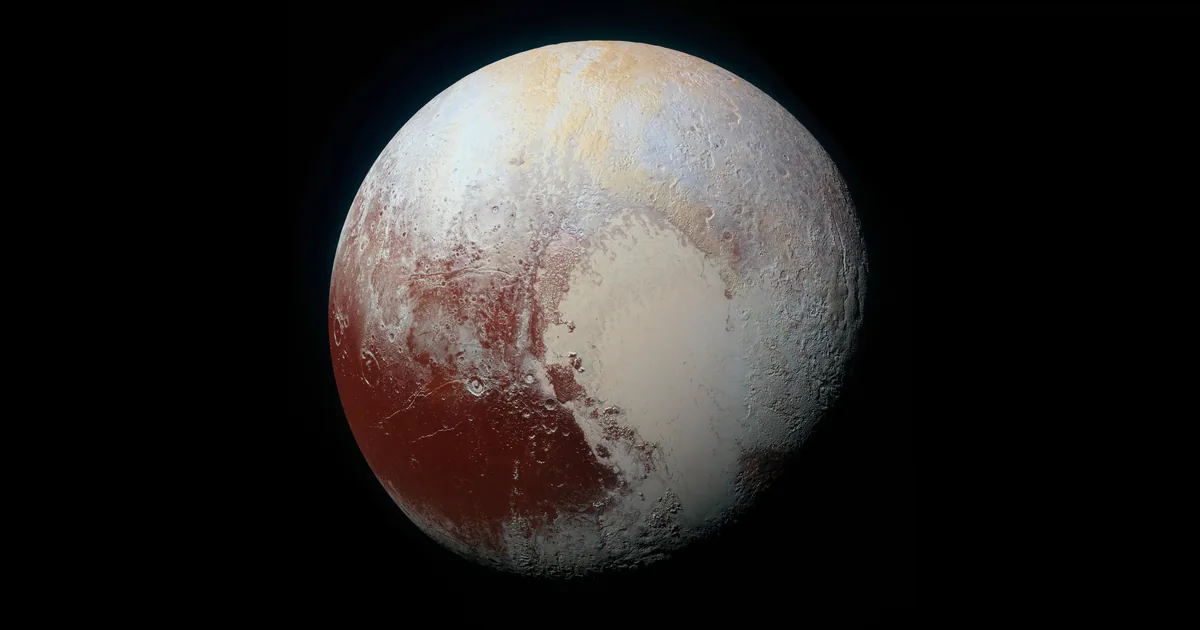
When NASA’s New Horizons spacecraft launched on 19 January 2006, its target was still considered the ninth planet: Pluto. Seven months later, the International Astronomical Union reclassified Pluto as a dwarf planet, which did not change the mission’s goal. New Horizons was to fill one of the last big blank spots on the map of the solar system. In 2015 it returned the first close-up images of Pluto, and in 2019 it flew past the Kuiper Belt object Arrokoth, the most distant body ever visited.
New Horizons at a Glance
| Property | Value |
|---|---|
| Operator | NASA (Johns Hopkins APL, led by Southwest Research Institute) |
| Launch | 19 January 2006 on an Atlas V rocket |
| Jupiter flyby | 28 February 2007 |
| Pluto flyby | 14 July 2015 at about 12,500 km |
| Arrokoth flyby | 1 January 2019 at about 3,500 km |
| Power | radioisotope generator (plutonium-238) |
| Distance from the Sun | about 65 AU (almost 10 billion km) |
| Status | active, extended until it leaves the Kuiper Belt around 2028/2029 |
The Long Road to Pluto
To cover the roughly 5 billion kilometers to Pluto in reasonable time, New Horizons left Earth at more than 58,000 km/h, making it the fastest spacecraft ever launched at the time. In February 2007 it flew past Jupiter. The gravity assist added about 14,000 km/h and shortened the journey by three years, and along the way it captured spectacular images of Io’s volcanoes.
For most of the almost ten-year journey, New Horizons was kept in hibernation to spare its systems, woken only once a year for checkouts.
The Historic Rendezvous with Pluto (2015)
On 14 July 2015, New Horizons sped past Pluto at a distance of only about 12,500 km. It could not enter orbit, as it was far too fast. All measurements therefore had to be made during the brief flyby, and transmitting the data back to Earth took more than a year.
Pluto: A Surprisingly Active World
Instead of a dead, cratered ball of ice, Pluto turned out to be a geologically lively world. Its best-known feature is the heart-shaped plain Sputnik Planitia, about 1,000 km wide, made of frozen nitrogen and almost free of impact craters; its ice is continually renewed by slow convection. There were also glaciers of nitrogen ice, water-ice mountains several kilometers high and signs of an ocean beneath the surface. Backlit by the Sun, the thin nitrogen atmosphere revealed blue haze layers.
Charon: Canyons and a Red Pole
Pluto’s largest moon Charon, half the size of Pluto itself, surprised scientists with huge canyons and a reddish polar region nicknamed “Mordor Macula”. Its material probably comes from Pluto’s atmosphere, captured on Charon and chemically altered.
Arrokoth and the Kuiper Belt
After Pluto, NASA sent the spacecraft deeper into the Kuiper Belt, the region beyond Neptune’s orbit where leftovers from the formation of the solar system circle the Sun. On 1 January 2019, New Horizons flew past the object (486958) Arrokoth, about 6.6 billion kilometers from Earth.
Arrokoth turned out to be a “contact binary”: two flattened bodies gently merged together, about 36 km long in total, reddish and barely changed since they formed some 4.5 billion years ago. Its shape shows that such bodies formed not through violent collisions but through the slow gathering of material, an important finding for planet formation. Arrokoth is still the most distant body ever explored up close.
Where Is New Horizons Today?
New Horizons is about 65 AU from the Sun, on a trajectory that, like the Voyager probes before it, will carry it out of the solar system. Its instruments remain active:
- Kuiper Belt: the spacecraft observes other Kuiper Belt objects from afar, from angles impossible from Earth.
- Heliosphere: it measures solar wind, dust and energetic particles in the outer heliosphere.
- Astronomy from afar: far from the scattered light of the inner solar system, New Horizons measured how bright the background of the universe is. In 2020 it photographed the nearby stars Proxima Centauri and Wolf 359, which appear visibly shifted from its vantage point: the first parallax measurement from such a distance.
For a while the mission’s future was uncertain: the US administration’s budget proposal for 2026 included cuts, but Congress secured continued operations. NASA plans to continue the mission until the spacecraft leaves the Kuiper Belt around 2028 or 2029. Its power source is expected to support radio contact into the 2030s.
Sources
More about Pluto and the other dwarf planets: Dwarf planets in the solar system. Its predecessors in the outer solar system are covered in the article on the Voyager mission.