

When we look up at the night sky, it is easy to imagine gravity as a simple force that pulls things straight down. If a star ventures too close to a supermassive black hole, or if a dying star collapses and becomes a Magnetar (a neutron star with the strongest magnetic fields in the universe), common sense suggests the surrounding matter should just fall directly into the gravitational well.
However, the universe rarely operates in straight lines. Instead of falling directly inward, matter spirals, creating flattened, glowing structures known as accretion disks. From the birth of planetary systems to the violent hearts of active galaxies, accretion disks are the fundamental engines of the cosmos. Understanding the physics of accretion disks means understanding how gravity, friction, and space-time interact to create the brightest objects in the universe.
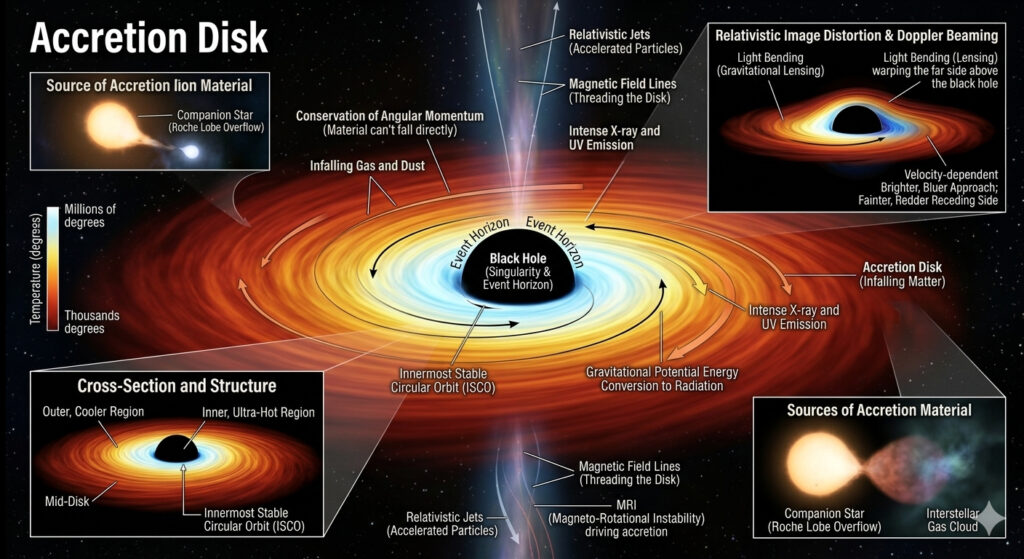
The Angular Momentum Barrier: Why Gas Doesn’t Just Fall In
To understand why an accretion disk forms, we have to look at one of the most unbreakable rules in physics: the conservation of angular momentum.
In space, almost everything is moving, and almost everything is rotating. When a cloud of interstellar gas is drawn toward a massive central object, whether that is a newborn star or a black hole, it carries a slight, almost imperceptible rotation. As gravity pulls the gas inward, the radius of the cloud shrinks. Just like an ice skater pulling their arms in to spin faster, the gas must spin faster as it gets closer to the central mass.
Eventually, the gas reaches a point where the outward centrifugal force of its rotation perfectly balances the inward pull of gravity. The gas can no longer fall inward; it is trapped in orbit. Because gas clouds are three – dimensional, particles collide with one another as they orbit, canceling out their up-and-down motions. Over time, these collisions flatten the spherical cloud into a two-dimensional plane – the accretion disk.
Friction, Heat, and the Viscosity Problem
If the gas is in a stable orbit, how does the black hole or magnetar ever “eat” it? For matter to move closer to the central object, it must lose some of its angular momentum. This is where the physics of accretion disks becomes incredibly complex.
In a standard fluid, viscosity (internal friction) allows faster-moving inner layers to drag against slower-moving outer layers. This friction transfers angular momentum outward, allowing the inner material to spiral inward. However, the gas in space is far too diffuse for standard friction to do the job. For decades, astrophysicists were puzzled by how accretion disks could operate efficiently.
The answer lies in magnetism. The plasma in an accretion disk is highly ionized, meaning it is full of charged particles. As these particles orbit, they generate and interact with magnetic fields. A mechanism known as the Magneto-Rotational Instability (MRI) acts as a powerful magnetic friction. Magnetic field lines connect different layers of the rotating disk like invisible rubber bands. The faster inner layers stretch these bands, transferring their angular momentum to the outer layers.
As the matter spirals inward, it loses gravitational potential energy. This energy doesn’t just disappear; it is converted into kinetic energy and intense heat. The fundamental physics governing this energy release can be expressed by the accretion luminosity formula:
$$L_{acc} = \frac{G M \dot{M}}{2 R}$$
Here, \(G\) is the gravitational constant, \(M\) is the mass of the central object, \(\dot{M}\) is the mass accretion rate, and \(R\) is the inner radius of the disk. The closer the material gets to the central mass, the hotter it becomes. In the inner edges of an accretion disk around a black hole, temperatures can soar to millions of degrees, causing the gas to emit brilliant X-rays.
The Ultimate Power Plant: Nuclear Fusion vs. Accretion
When we think of cosmic power, we usually think of nuclear fusion – the process that powers our Sun. Fusion is impressive, converting about 0.7% of its mass into energy. However, it is remarkably inefficient compared to the sheer gravitational terror of an accretion disk.
Because an accretion disk extracts energy from a deep gravitational well, it is vastly more efficient than nuclear fusion. For a standard, non-rotating black hole, accretion can convert about 6% of the infalling mass into pure energy. But if the black hole is spinning rapidly (a Kerr black hole), the inner edge of the accretion disk can sit much closer to the event horizon. In these extreme cases, accretion can reach an astounding thermodynamic efficiency of up to 42%.
Pound for pound, an accretion disk is the most efficient power plant in the known universe. This is why Quasars – supermassive black holes actively feeding on disks of gas – can outshine the combined light of hundreds of billions of stars.
Frame-Dragging and the Lense-Thirring Effect
The physics of accretion disks becomes truly mind-bending when we apply Albert Einstein’s theory of General Relativity. When the central object is incredibly dense and spinning rapidly—such as a newborn magnetar driving a superluminous supernova—it doesn’t just sit in space; it twists the fabric of space-time around with it.
This phenomenon is known as frame-dragging. If the accretion disk is tilted relative to the spin equator of the central magnetar or black hole, the twisted space-time exerts a relentless twisting force (torque) on the disk.
This causes the entire accretion disk to wobble like a spinning top that is beginning to lose momentum. In astrophysics, this wobble is called Lense-Thirring precession. When we observe the intense radiation coming from the inner edge of such a disk, this wobbling causes the light to fluctuate. Observers on Earth see these fluctuations as distinct, rhythmic “bumps” or a “chirp” in the light curve of the object.
Detecting this precise wobble is the ultimate smoking gun for astrophysicists. It proves not only the existence of the accretion disk but also allows scientists to directly measure the spin and magnetic field of the monster hiding in its center.
A Universal Mechanism
Accretion disks are a universal constant, operating across vastly different scales of mass and time. The same fundamental physics of angular momentum and magneto-rotational instability govern the cool, dusty disks that forge young exoplanets, as well as the ultra-hot, relativistic vortexes of plasma plunging into supermassive black holes. By studying how these cosmic drains function, we learn how the universe builds, destroys, and illuminates itself.