

Amateur Photometry of Supernova SN 2025ahxd in UGC525 (PGC3020)
Introduction
There is a common misconception that scientifically valuable astronomical data remains the exclusive domain of professional observatories. While amateurs cannot compete with the depth and cadence of surveys like the Zwicky Transient Facility (ZTF), dedicated backyard astronomers can provide crucial supplementary data, especially in monitoring transient events like supernovae.
This project aimed to test the photometric limits of modest amateur equipment specifically, a 60mm achromatic refractor telescope. The target was SN 2025ahxd, a Type Ia supernova recently discovered in the galaxy UGC 525. The goal was not just to image the object, but to generate a scientifically usable light curve tracking its decline from maximum brightness and to compare these results against professional data.
SN 2025ahxd
SN 2025ahxd (internally designated by the Zwicky Transient Facility as ZTF25ackdapv) was first detected on December 22, 2025, as a faint 20th-magnitude spark in the outskirts of the spiral galaxy UGC 525. Located roughly 230 million light-years away in the constellation Pisces, this event was quickly identified as a Type Ia supernova – the thermonuclear explosion of a white dwarf star in a binary system. Known as “standard candles,” Type Ia supernovae are the gold standard for measuring cosmic distances because they explode with nearly identical intrinsic brightness. Throughout early January 2026, SN 2025ahxd steadily climbed in luminosity, peaking at a magnitude of approximately 15.4, bright enough to be a fantastic target for small-aperture telescopes and a perfect subject for our photometric study.
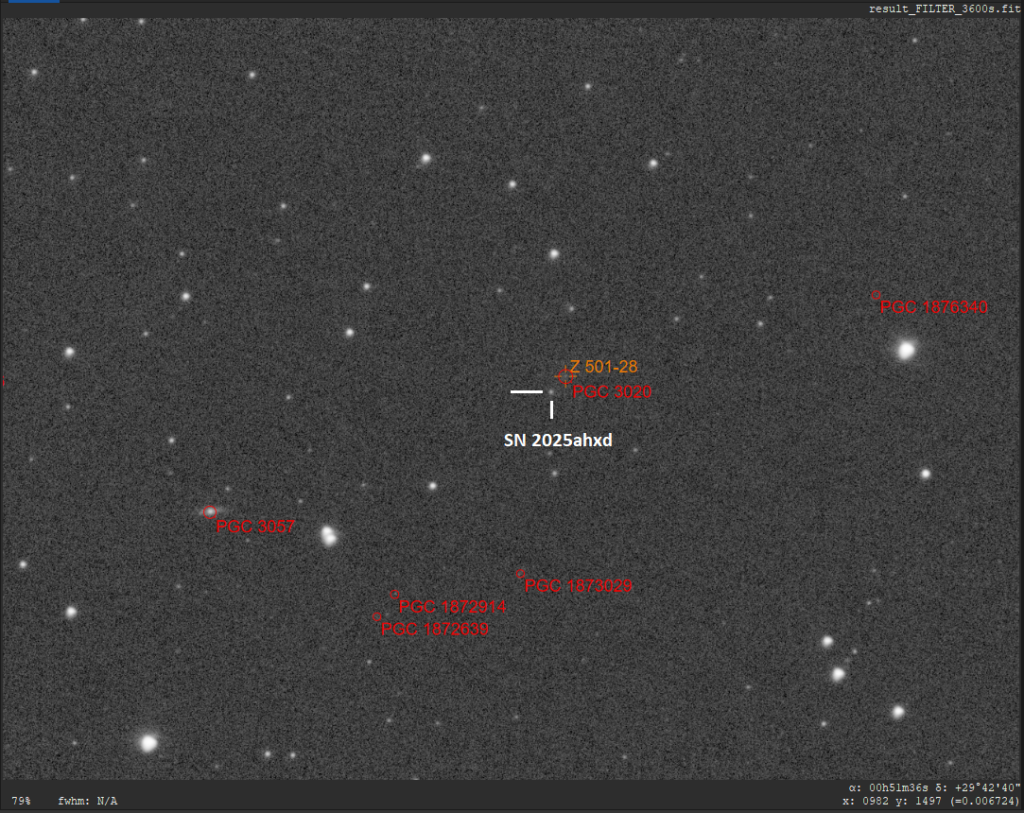
Image of SN 2025ahxd in UGC525 (PGC3020) on January, 11th 2026
Scientific Context: The Importance of Type Ia Supernovae
A supernova is the explosive end of a star’s life, briefly outshining its entire host galaxy. They are classified based on their spectral signature, which reveals the mechanism of the explosion.
SN 2025ahxd is classified as a Type Ia supernova. Unlike core-collapse supernovae (Type II), which occur when massive stars run out of fuel, a Type Ia event is a thermonuclear explosion of a carbon-oxygen white dwarf existing in a binary system. The white dwarf accretes matter from a companion star until it reaches a critical mass (the Chandrasekhar limit), triggering runaway nuclear fusion that obliterates the star.
Because they explode at a consistent mass threshold, Type Ia supernovae have very similar intrinsic peak luminosity. This characteristic makes them “standard candles” for astronomers. By measuring how bright they appear from Earth, astronomers can calculate precise distances to their host galaxies, a technique that was pivotal in discovering the accelerating expansion of the universe.
A typical Type Ia light curve rises rapidly to peak brightness, then fades. Notably, in redder wavelengths (red and near-infrared bands), the light curve often exhibits a “shoulder” or a secondary plateau roughly 15 to 20 days after the peak, caused by the changing opacity of iron-group elements in the expanding debris cloud. Capturing this phase was a primary objective of this observation campaign.
Equipment and Challenge
The primary challenge of this project was the limited light-gathering power of the optical system. As the supernova faded past magnitude 15, the signal-to-noise ratio (SNR) dropped, requiring rigorous data acquisition and processing techniques to extract accurate measurements from the background sky noise.
Imaging Train:
- Telescope: 60mm achromatic Refractor
- Camera: ToupTek G3M178M (uncooled)
- Filters: Red (Wratten 25) + UV/IR Cut. This combination creates a “synthetic R-band” (R-synth) response, approximating standard photometric red filters used by professionals.
- Mount: Equatorial, tracking but no auto-guiding
Technical Methodology: Differential Photometry
To obtain accurate magnitude measurements, the technique of differential photometry was employed using the software AstroImageJ (AIJ).
Unlike absolute photometry, which requires perfectly calibrated sky conditions and standard stars across the sky, differential photometry measures the brightness of the target relative to known, non-variable comparison stars within the same field of view. Because atmospheric changes (like thin clouds or changing airmass) affect the target and comparison stars equally, their effects cancel out, yielding precise relative measurements.
The Workflow:
- Data Acquisition: Each observation session consisted of gathering multiple 60-second exposures (typically 30 to 60 frames depending on conditions). Calibration frames bias, darks, and flats were also acquired to correct sensor noise and optical vignetting.
- Preprocessing: Images were calibrated and stacked (using Siril) to increase the total integration time, thereby boosting the SNR of the faint supernova.
- Comparison Star Selection: The differential photometry was anchored using comparison stars selected from the Gaia catalog. To optimize the calibration for the R-synth passband, stars with redder color indices (higher B-V values) were specifically prioritized. This selection strategy is important when tracking a supernova, as it minimizes color-dependent systematic errors – known as transformation errors – by ensuring the spectral profile of the reference stars more closely matches the red-dominated flux of the target. The primary stars utilized for this project featured Gaia G-band magnitudes of 13.19 and 13.59, providing stable, high-precision anchors throughout the observation campaign.
- Photometric Measurement in AIJ: Apertures were placed around the supernova and comparison stars. AIJ calculated the net counts of the target by subtracting the background sky brightness. The instrument magnitude of the SN was then calculated relative to the known magnitudes of the comparison stars.
- Error Analysis: Photometric uncertainty was calculated based on the SNR of the target and comparison stars. As the supernova faded, the lower SNR resulted in naturally higher uncertainty bars.
Results and Analysis
Observations began shortly after the supernova’s peak brightness and continued through its “plateau” phase and into its final linear decline.
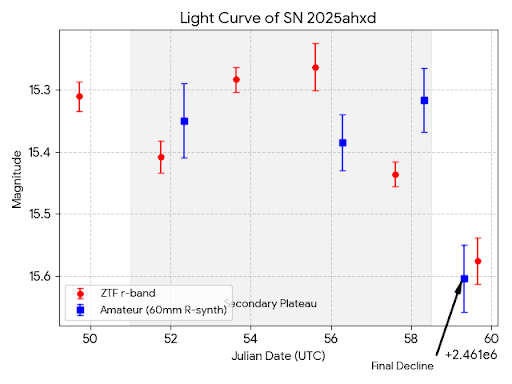
The resulting lightcurve demonstrates remarkable consistency. Despite using a different filter passband (R-synth) compared to the professional ZTF r-band, the amateur data tracks the professional survey’s trend with high fidelity.
Key Observations:
- The Plateau: Between January 11th and January 17th, the supernova’s fading slowed significantly, hovering between magnitude 15.3 and 15.4. This data successfully captured the characteristic Type Ia secondary plateau in the red band.
- The Decline: On the night of January 18th, the measured magnitude dropped sharply to 15.60 (±0.05). A ZTF observation taken just eight hours later at magnitude 15.58 confirmed that this drop was a real physical event, marking the end of the plateau phase.
Below is the final dataset and light curve plot showing the integrated amateur data and professional observations (Reference: ZTF Observations).
Integrated Data Table: SN 2025ahxd
| Date (UTC) | Julian Date (UTC) | Mag. | Uncertainty (±) | Band | Source | Phase |
| 2026-01-09 05:15 | 2461049.719 | 15.311 | 0.024 | r | ZTF | Plateau |
| 2026-01-11 06:11 | 2461051.758 | 15.408 | 0.026 | r | ZTF | Plateau |
| 2026-01-11 19:56 | 2461052.331 | 15.35 | 0.06 | R-synth | Amateur (60mm) | Plateau |
| 2026-01-13 03:17 | 2461053.637 | 15.284 | 0.020 | r | ZTF | Plateau |
| 2026-01-15 02:49 | 2461055.618 | 15.264 | 0.038 | r | ZTF | Plateau |
| 2026-01-15 18:42 | 2461056.279 | 15.385 | 0.045 | R-synth | Amateur (60mm) | Plateau |
| 2026-01-17 02:39 | 2461057.611 | 15.436 | 0.020 | r | ZTF | Plateau End |
| 2026-01-17 19:35 | 2461058.317 | 15.317 | 0.051 | R-synth | Amateur (60mm) | Plateau End |
| 2026-01-18 19:23 | 2461059.308 | 15.604 | 0.054 | R-synth | Amateur (60mm) | Decline Start |
| 2026-01-19 03:39 | 2461059.652 | 15.575 | 0.037 | r | ZTF | Decline Confirmed |
Note: Minor offsets between ZTF r-band and Amateur R-synth magnitudes are expected due to differences in filter transmission curves.
Conclusion
This project demonstrated that a 60mm refracting telescope is capable of producing scientifically valid photometric data for transient objects down to approximately magnitude 15.6. By employing rigorous differential photometry techniques, the campaign successfully documented the post-peak evolution of a Type Ia supernova, providing a lightcurve that perfectly matches professional survey data.
The observation on January 18th, catching the beginning of the final decline at magnitude 15.6, marked the practical limit of the equipment for reliable quantitative measurements. Pushing small optics to their limit is not just a technical challenge; it is a rewarding way for amateur astronomers to connect directly with the universe.