
Uranus: The Ice Giant with the Tilted Axis
Overview and Key Characteristics
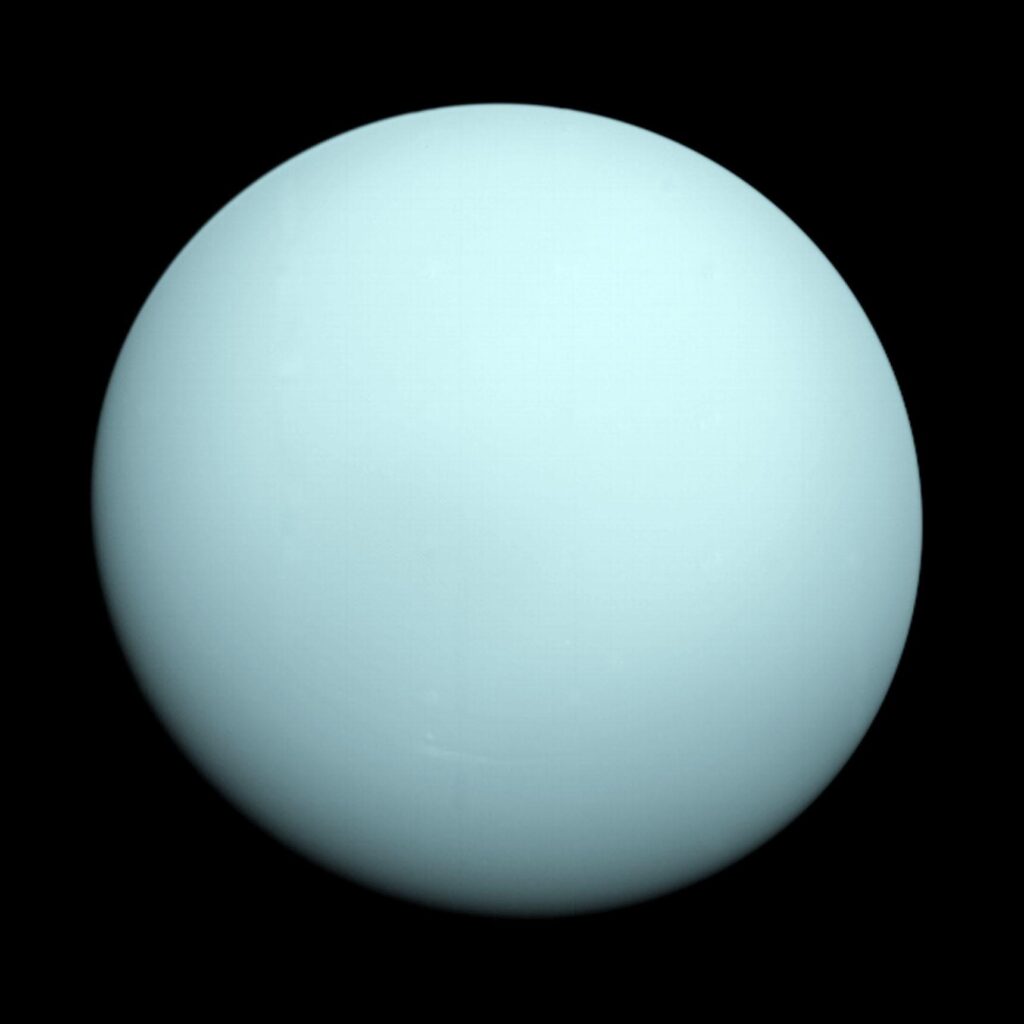
Uranus, the seventh planet from the Sun, stands as a serene yet mysterious sentinel in the outer reaches of the solar system. Classified as an Ice Giant, it is compositionally distinct from its larger neighbors, Jupiter and Saturn. Rather than being mostly gas, Uranus is primarily composed of “ices” – dense fluids of water, ammonia, and methane – surrounding a small, rocky core. The presence of methane in its upper atmosphere is what gives the planet its iconic, uniform cyan hue, as the gas absorbs red wavelengths of sunlight and reflects the brilliant blue-green spectrum back into space.
The most striking feature of Uranus is its unparalleled axial tilt of 98 degrees. Likely the result of a cataclysmic collision early in its formation, this tilt causes the planet to rotate effectively on its side. This orientation results in the most extreme seasons in the solar system, with each pole facing the Sun or total darkness for 42 Earth years at a time. Despite being closer to the Sun than Neptune, Uranus holds the title for the coldest atmosphere in the planetary system, with temperatures dropping as low as -224 °C (-371 °F). Guarding this pale giant is a complex system of 13 faint, vertical rings and a diverse family of 28 moons, named after the immortal characters of William Shakespeare and Alexander Pope.
Planetary Data Table
| Characteristic | Value |
|---|---|
| Diameter | 50,724 km |
| Mass | 8.681 x 10^25kg (approx. 14.5 Earth masses) |
| Mean Distance from Sun | 2.87 billion km (approx. 19.2 AU) |
| Orbital Period | 84 years |
| Rotational Period (Day) | 17 hours 14 minutes |
| Surface Temperature | -224 °C (coldest planet) |
| Atmosphere | 83 % Hydrogen, 15 % Helium, 2 % Methane |
| Number of Moons | 27 (known) |
| Ring System | 13 thin, dark rings |
| Axial Tilt | 98° (rotates on its side) |
The Unique Axial Tilt
Uranus is the only planet in the solar system whose rotational axis is nearly parallel to its orbital plane, with an extreme tilt of about 98°. This means Uranus rotates virtually on its side, causing highly unusual and extreme seasons: one pole experiences 42 years of darkness, followed by 42 years of continuous sunlight.
Atmosphere and Temperature
The atmosphere is mostly hydrogen and helium, with 2 % methane responsible for its color by absorbing red light. Despite not being the most distant planet, Uranus is the coldest planet in the solar system, with temperatures dropping to -224 °C.
Rings and Moons
Uranus has a system of 13 known rings, which are notably much thinner and darker than those of Saturn. They are primarily composed of small particles of frozen water and dark organic compounds.
The planet has 27 known moons, named after characters from the works of William Shakespeare and Alexander Pope. The largest include Titania, Oberon, Umbriel, Ariel, and Miranda. Each moon exhibits unique geological features such as vast canyons and ice cliffs.
Magnetic Field and Exploration
Uranus’s magnetic field is also anomalous: it is highly tilted at approximately 59° relative to its rotation axis and is offset from the planet’s center. This asymmetrical field suggests a complex and not fully understood internal structure.
Only one spacecraft, Voyager 2, has ever studied Uranus up close, during its flyby in 1986. This mission provided the first detailed images and data on its magnetic field and ring system. Due to its unique composition as an Ice Giant and its unusual tilt, Uranus remains a crucial and largely unexplored target for future planetary science missions.
Magnetic Field Anomaly and Geological Surprises
Among Voyager 2’s most significant findings at Uranus was the highly anomalous nature of its magnetic field. The spacecraft’s magnetometer data revealed that the magnetic axis is tilted at an extreme angle—approximately 59 degrees—relative to the planet’s rotational axis. Furthermore, the field’s center is significantly offset from the planet’s geometric center. This extreme misalignment challenges the standard dynamo theory, which typically predicts a field aligned with the rotation axis and originating deep within the core. This discovery suggests that Uranus’s magnetic field may be generated in a shallow, conductive layer, perhaps an “ionic ocean” of water and ammonia, rather than the deep metallic cores of gas giants like Jupiter and Saturn. Voyager 2 also captured detailed images of the moon Miranda, revealing a chaotic surface characterized by massive fault canyons, towering ice cliffs, and peculiar chevron-shaped regions known as “coronae.” This jumbled landscape implies a violent and complex geological history, possibly involving tidal heating, internal differentiation, or catastrophic fragmentation and reassembly.