

As excitement builds for the upcoming perihelion of Comet C/2026 A1 (MAPS), astronomers and stargazers alike are looking to the skies with a mix of anticipation and scientific curiosity. However, to truly understand the nature of this new celestial visitor, we have to look far beyond our modern observatories. We have to rewind the cosmic clock by more than two millennia to uncover the origins of a celestial dynasty.
Comet MAPS is not a solitary wanderer; it is a member of the famous Kreutz sungrazer family. Like all families, this one has a patriarch—a massive, ancient body known as the Kreutz progenitor comet. To trace its roots, we must travel back to the winter skies of ancient Greece, specifically to the year 372–371 BC, when an astronomical event terrified a civilization and left a permanent scar on the solar system.
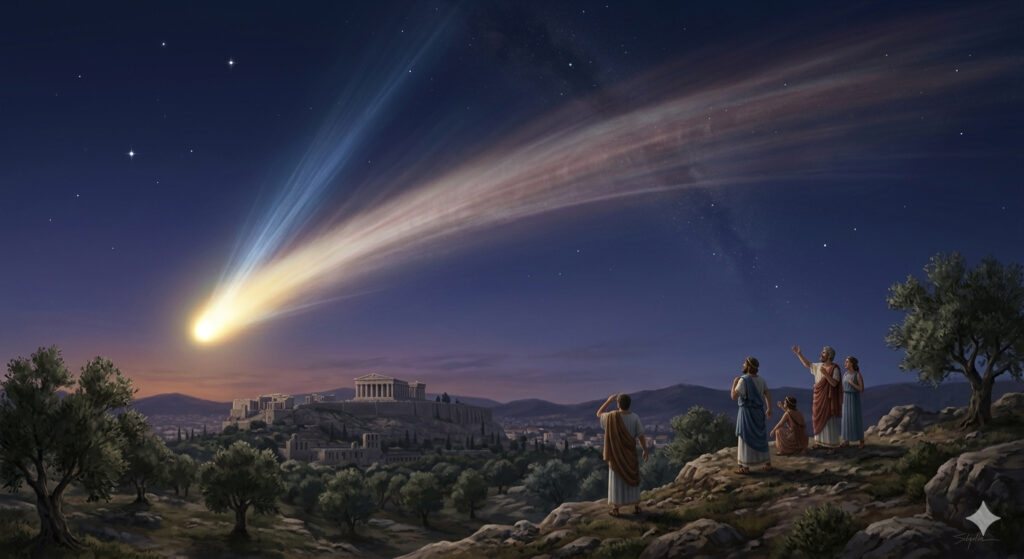
A Sky on Fire: The Winter of 371 BC
In the 4th century BC, humanity’s understanding of the cosmos was deeply intertwined with mythology and philosophy. It was during this era, specifically recorded around the archonship of Asteius, that a “Great Comet” appeared in the western sky.
The most famous account of this event comes from the legendary Greek philosopher Aristotle, who observed the comet when he was just a young man. In his seminal work Meteorologica, Aristotle described a horrifyingly beautiful spectacle. He noted that the comet appeared during a period of clear, frosty winter weather, rising in the west immediately after sunset.
According to Aristotle, the comet’s tail was not just a faint smudge; it was a blazing path that stretched across a third of the sky, reaching as high as the belt of Orion. Other historians of antiquity, quoting sources that have since been lost to time, described the comet as a “flaming beam” or a “blazing torch.” The object was so intensely luminous that it reportedly cast shadows on the Earth, a phenomenon usually reserved for the full Moon.
Adding to the dread of the ancient Greeks, the arrival of this comet coincided with a catastrophic earthquake and tsunami in Achaea, which utterly destroyed the coastal cities of Helike and Boura. For centuries, the comet was viewed as a divine portent of this geological disaster. Today, however, astrophysicists recognize it as one of the most significant astronomical events in recorded human history.
A Comet Broken by the Sun
While Aristotle provided the empirical data of the comet’s size and trajectory, it was another Greek historian, Ephorus of Cyme, who reported the most crucial detail for modern astronomy. Ephorus claimed that as the world watched, the great comet literally split into two distinct stars.
For many years, Ephorus’s claim was dismissed by later philosophers (including the Roman writer Seneca) as an exaggeration or a physical impossibility. Modern astrophysicists, such as Dr. Zdenek Sekanina, point out that while a human being likely couldn’t have resolved the physical fragmentation of the nucleus with the naked eye, the historical record points to a very real and violent astrophysical process.
The Great Comet of 371 BC was a “sungrazer.” Its highly eccentric orbit took it perilously close to the surface of the Sun—well within the solar corona. When an object of that immense size (estimated by some modern models to be over 100 kilometers in diameter) gets that close to our star, it experiences unimaginable thermal stress and gravitational tidal forces. The difference in gravitational pull between the side of the comet facing the Sun and the side facing away was so extreme that it overcame the structural integrity of the comet’s icy nucleus.
The comet did not just survive its fiery encounter; it fractured. This primary fragmentation event is considered by many dynamicists to be the birth of the Kreutz sungrazer family.
Heinrich Kreutz and the Cosmic Family Tree
The connection between the ancient Great Comet of 371 BC and the comets we see today was not made until the late 19th century. German astronomer Heinrich Kreutz dedicated his career to studying the orbital paths of several spectacular comets, including the Great Comet of 1843 and the Great September Comet of 1882.
Kreutz realized a stunning pattern: these distinct comets were not independent bodies. They were traveling on nearly identical orbital highways. By mathematically tracing their trajectories backward in time, Kreutz proposed that they were all fragments of a single, colossal parent body that had shattered centuries earlier.
Modern dynamic orbital modeling has confirmed Kreutz’s hypothesis. Today, it is widely accepted by astronomers that the Kreutz progenitor comet – likely the very object witnessed by Aristotle – underwent what is known as “cascading fragmentation.” The two main halves created during that ancient perihelion separated by mere meters per second. As they moved away from the Sun, they continued to silently crumble in the freezing depths of the outer solar system.
A 2,000-Year-Old Debris Trail
When these fragments eventually returned to the inner solar system, they did so not as one object, but as a swarm of icy shrapnel.
The larger chunk of the 371 BC split is theorized to have returned as the Great Comet of 1106, which fragmented yet again. This secondary breakup spawned some of the most famous comets of the modern era, including the brilliant Comet Ikeya-Seki in 1965 and Comet Lovejoy in 2011.
Because the original parent comet was so incredibly massive, its debris trail now litters the orbital path. The Solar and Heliospheric Observatory (SOHO) satellite has discovered thousands of these tiny, house-sized Kreutz fragments plunging into the Sun and vaporizing completely. They are the microscopic dust of the 371 BC titan.
The Latest Chapter: C/2026 A1 (MAPS)
This brings us back to the present day and the arrival of C/2026 A1 (MAPS). When you look up at this comet in the evening sky, you are not just looking at a dirty snowball; you are witnessing a piece of ancient history.
Comet MAPS is a direct descendant of the Kreutz progenitor comet. The ice sublimating off its surface and forming its glowing tail is the exact same material that terrified Aristotle and the ancient Greeks over 2,300 years ago. As MAPS approaches its own harrowing perihelion on April 4, 2026, it faces the same trial by fire that shattered its ancestor. Whether it survives to put on a spectacular show or disintegrates into the solar corona, it is playing its part in a cosmic drama that has spanned millennia.
The Great Comet of 371 BC is still with us, continuing its long, slow dissolution into the fire of our star.
References & Historical Sources
Primary Historical Accounts:
- Aristotle. (c. 350 BC). Meteorologica (Book I, Part 7). Aristotle’s firsthand account of the comet’s size, brightness, and its appearance near the belt of Orion.
- Ephorus of Cyme. (c. 340 BC). Universal History (as cited by Seneca in Naturales Quaestiones). The source for the observation of the comet nucleus splitting into two distinct parts.
Modern Scientific Research:
- Kreutz, H. (1888). Untersuchungen über das System der Cometen 1843 I, 1880 I und 1882 II. Publication of the original research linking these comets to a single progenitor.
- Sekanina, Z., & Chodas, P. W. (2004). Fragmentation Hierarchy of Bright Sungrazing Comets and the Birth and Evolution of the Kreutz System. The Astrophysical Journal. The definitive modern study on the cascading fragmentation that started in 371 BC.
- Marsden, B. G. (1967). The Sungrazing Comet Group. The Astronomical Journal. Essential research on the orbital dynamics of the Kreutz family.