

A Photometric Analysis of the Luminous Red Nova (LRN) AT2025abao with Amateur Tools
Object: AT2025abao (Luminous Red Nova)
Host Galaxy: Andromeda (M31)
Current Status: Post-Maximum Decline Phase
Abstract
AT2025abao is a Luminous Red Nova (LRN) located in M31, the Andromeda Galaxy. Following its discovery in October 2025 and a subsequent peak in late 2025, the object is now transitioning through its decline phase. This article provides photometric data and technical analysis of the event’s evolution, utilizing V-band and R (“Rsynth”) CCD/CMOS observations to track its luminosity changes.
1. Stellar Mergers and Luminous Red Novae
Luminous Red Novae (LRN) are rare astronomical transients resulting from the merger of two stars in a binary system, a process scientifically known as Common Envelope Evolution. As the stellar orbits decay, the stars eventually coalesce into a single object. During this merger, a significant portion of the shared stellar envelope is ejected, creating a rapidly expanding and cooling photosphere. This physical evolution causes the object’s characteristic shift toward longer, redder wavelengths and produces a distinct light curve that differs significantly from both the thermonuclear explosions of classical novae and the core-collapse events of supernovae.
Discovery and Early Observations
AT2025abao (also cataloged as MASTER OT J003848.65+404607.5) was first identified on October 17, 2025, by the prolific Japanese astronomer Koichi Itagaki. Located in the southwest region of the Andromeda Galaxy (M31), the transient was initially detected at a faint magnitude of approximately 17.8.
Following the initial detection, the object underwent a notable brightening phase. By late October 2025, it reached a peak visual magnitude of approximately 14.6, becoming one of the brightest extragalactic transients visible in the northern hemisphere at that time. This brightness made it an accessible target for amateur telescopes and a subject of intense study for professional observatories like the Zwicky Transient Facility (ZTF).
Current Scientific Understanding
LRNe like AT2025abao are considered “intermediate-luminosity optical transients. They are brighter than standard novae but generally fainter than supernovae. Archival data from surveys such as Pan-STARRS suggest that the progenitor of this event was a faint, red stellar system around magnitude 21, which is consistent with a binary system undergoing a “merge-burst.”
As of early 2026, the object is in a slow decline. Because LRNe often produce vast amounts of dust as their ejected shells expand, they frequently show a secondary “plateau” or even a resurgence in infrared brightness as the visible light fades. Tracking the current fade rate is essential for determining the total energy released and the mass of the ejected material.
2. Observation Logs & Data Acquisition
The following observations were conducted under average-to-good seeing conditions, with the target positioned near the zenith to minimize atmospheric extinction.
| Parameter | Specification |
| Optics | 60mm Achromatic Refractor (measured focal length: 488mm) |
| Sensor | ToupTek G3M178M (IMX178 CMOS) |
| Filters | Bessel V-Band + UV/IR Cut |
| Integration | 42 x 60s (42 minutes total) |
| Calibration | Darks, Bias, Flats applied in Siril |
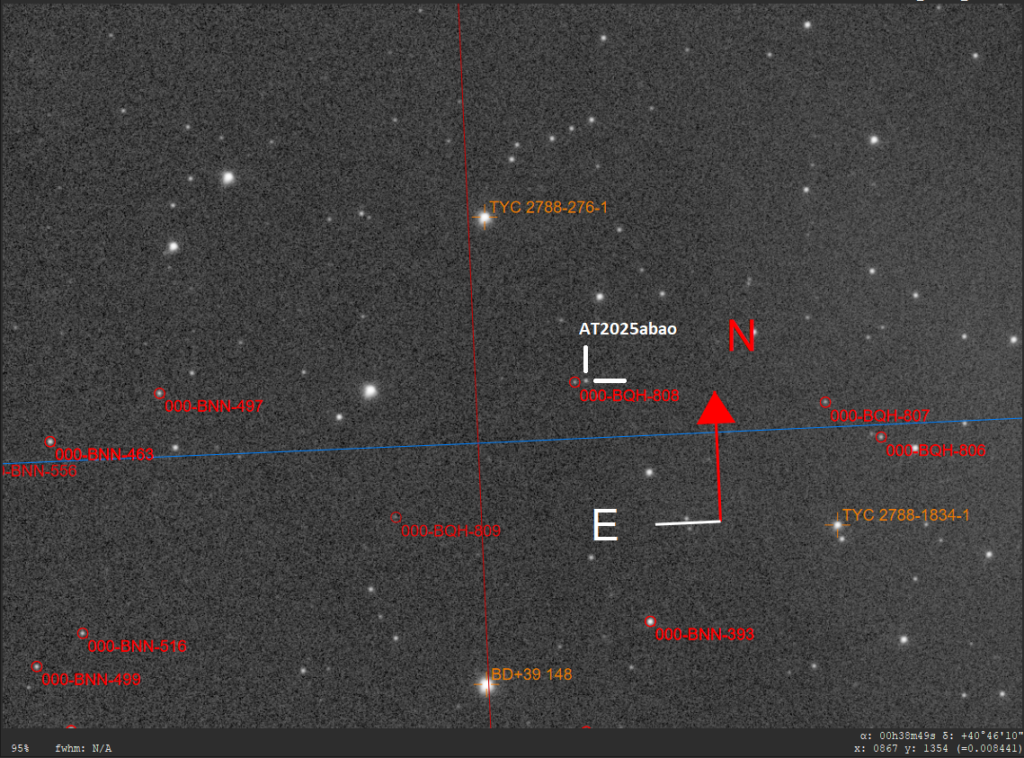
3. Photometric Analysis: January 7, 2026
Differential photometry was performed using AstroImageJ (AIJ). Comparison stars were selected from the AAVSO database, prioritizing targets with B-V color indices between 0.60 and 0.77 to align with the expected spectral profile of the LRN and mitigate potential color-dependent errors inherent in achromatic optics.
Results of Measurement (2026-01-07):
- Mean Magnitude: 15.08 V
- Statistical Error: ± 0.03 mag (including catalog uncertainty)
- Limiting Magnitude: 16.0 V
4. Evolutionary Trend
Initial reports in October 2025 placed the object at magnitude 17.8. Historical data from the Transient Name Server (TNS) indicate that AT2025abao reached a peak brightness of approximately 14.6 V in late 2025.
Our current measurement of 15.08 V confirms the object has begun its descent from the maximum. The current fade rate provides critical data for modeling the expansion velocity and cooling rate of the ejected stellar envelope.
5. Observations & Color Index
(Updated: 2026-01-12)
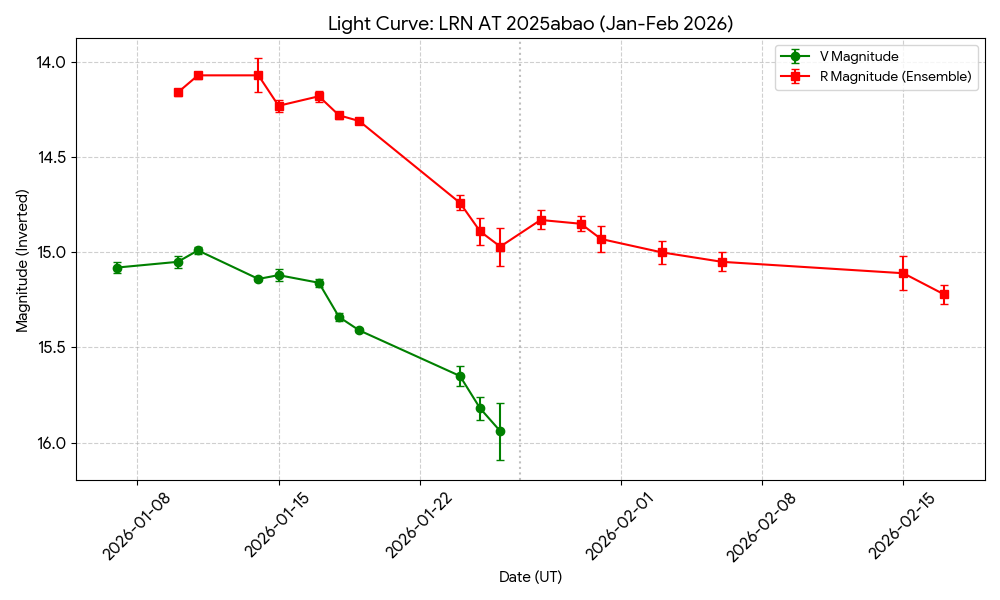
The dual-filter monitoring campaign is now active. By combining V-band (Visual) and a calibrated “Synthetic Red” (Rsynth), we are tracking the expanding and cooling photosphere of the merger remnant. The following data highlights a clear transition: while the object is brightening overall, it is doing so much more rapidly in the red end of the spectrum.
Photometry Data LRN AT2025abao
| Date (UT) | Magnitude (V) | Magnitude (Rsynth) | Color Index (V-R) | Phase / Notes |
| 2026-01-07 | 15.08 ± 0.03 | — | — | Initial Observation (V-only) |
| 2026-01-10 | 15.05 ± 0.03 | 14.16 ± 0.02 | +0.89 | Pre-Peak Plateau |
| 2026-01-11 | 14.99 ± 0.02 | 14.07 ± 0.02 | +0.92 | Plateau Peak |
| 2026-01-14 | 15.14 ± 0.01 | 14.07 ± 0.09 | +1.07 | V-Fade / R-Plateau (Clouds) |
| 2026-01-15 | 15.12 ± 0.03 | 14.23 ± 0.03 | +0.89 | Post-Peak Fade |
| 2026-01-17 | 15.16 ± 0.02 | 14.18 ± 0.03 | +0.98 | Red Rebound |
| 2026-01-18 | 15.34 ± 0.02 | 14.28 ± 0.02 | +1.06 | Fast Decline |
| 2026-01-19 | 15.41 ± 0.01 | 14.31 ± 0.01 | +1.10 | Deep Reddening |
| 2026-01-24 | 15.65 ± 0.05 | 14.74 ± 0.04 | +0.91 | Consistent Decline |
| 2026-01-25 | 15.82 ± 0.06 | 14.89 ± 0.07 | +0.93 | Steady Fading |
| 2026-01-26 | 15.94 ± 0.15 | 14.97 ± 0.10 | +0.97 | (V) Equipment Limit reached |
| 2026-01-28 | — | 14.83 ± 0.05 | — | 2×2 Binning Test / Plateau |
| 2026-01-30 | — | 14.85 ± 0.04 | — | Plateau confirmed (High SNR) |
| 2026-01-31 | — | 14.93 ± 0.07 | — | Haze & Full Moon |
| 2026-02-03 | — | 15.00 ± 0.06 | — | Slow decline |
| 2026-02-06 | — | 15.05 ± 0.05 | — | |
| 2026-02-15 | — | 15.11 ± 0.09 | — | Sahara dust, bad SNR |
| 2026-02-17 | — | 15.22 ± 0.05 | — | Final data point, good conditions |
Analysis: Physical Trend vs. Measurement Noise
A common challenge in amateur photometry is distinguishing between real stellar variability and “scatter” caused by seeing or sky transparency. To ensure data integrity, we implemented the following:
- Differential Photometry: By measuring the Nova against a stable “trio” of AAVSO-calibrated comparison stars (000-BNN-443, -444, and -463) within the same field of view, atmospheric extinction and thin clouds are mathematically cancelled out.
- 16-bit Linear Pipeline: We transitioned to a 16-bit unsigned integer workflow. This ensures that the high Signal-to-Noise Ratio (SNR) of our stacked images is preserved, providing a Zero-Point accuracy of ~0.02 mag.
- Statistical Significance: Between Jan 10 and 11, the Red-band brightened by 0.09 mag. This shift is nearly 5 times larger than our calculated system scatter (a “5-sigma” detection), confirming that the brightening is a real physical event.
Scientific Conclusion: The “Growing Giant”
The observed trend – simultaneous brightening in both bands with a widening V-R index – is a classic signature of a Luminous Red Nova (LRN) expansion.
As the binary merger remnant expands, its surface area increases, which causes the total brightness to rise (the “Luminous” part). Simultaneously, the gas is cooling, shifting the peak of its light emission toward the red (the “Red” part). The jump in color index from +0.89 to +0.92 is direct evidence of this rapid cooling phase.
Phase 2: The “Red Rebound” & Cooling Acceleration (Update Jan 18)
Data captured between January 17th and 18th marks a decisive shift in the Nova’s evolution. While the previous week was defined by expansion and brightening, we have now entered a phase of rapid cooling.
- The “Red Rebound” (Jan 17th): Our data showed a temporary divergence: while the visual brightness (V) continued to fade, the Red brightness stabilized and even recovered slightly. This physical “pause” in the red band caused the color index to widen to +0.98, proving that the energy output was shifting toward longer wavelengths.
- The Fast Decline (Jan 18): Just 24 hours later, the fade accelerated dramatically. We recorded a V-band drop of 0.18 mag in a single day, the steepest decline observed so far.
- Crossing the Threshold: This collapse in visual light pushed the Color Index to +1.06, officially crossing the +1.0 “Red Source” threshold. This indicates that the merger remnant is cooling so quickly that its peak emission is moving deeper into the infrared, and we may be witnessing the first stages of dust formation beginning to obscure the photosphere.
- The Transition to a “Cooling Plateau” (Update Jan 19th): After the sharp drop on the 18th, the most recent data shows the decline is beginning to “brake.” While the Visual light (V) fell by another 0.07 mag, the Red-band (R) remained remarkably stable, dipping by only 0.03 mag. This growing disparity pushed the Color Index to a record +1.10.
- This suggests the object has reached a temperature where the photosphere is now predominantly emitting in the long-wave red and infrared. The high Signal-to-Noise Ratio (SNR ~50) of this session (very good seeing and weather conditions also contributed to this) confirms that this extreme reddening is a high-confidence physical detection, not measurement noise.
Update January 26th: Fading into the Grey – 3-Day Analysis at the Limit
This marks the end of our intensive observation campaign for LRN AT 2025abao.
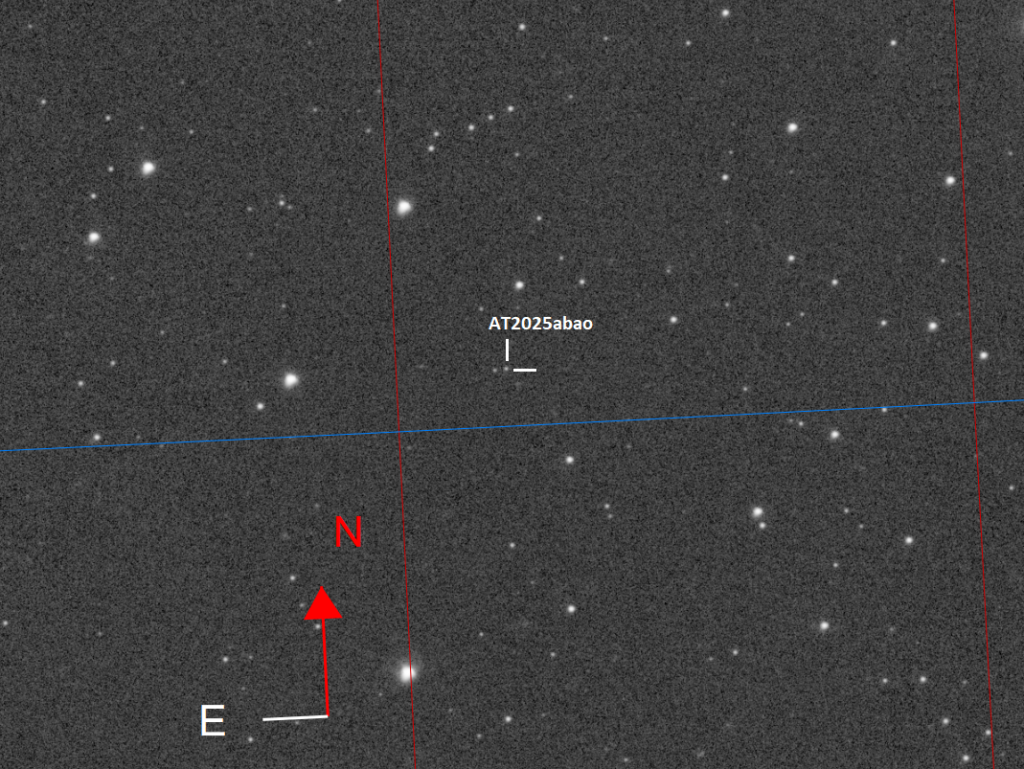
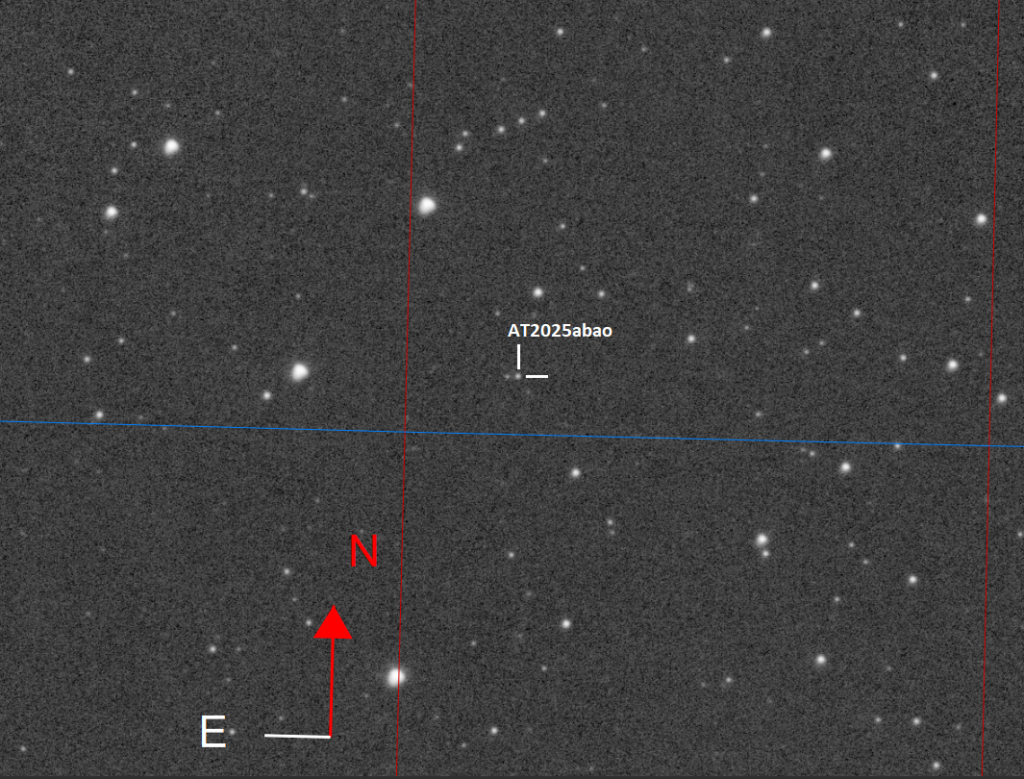
Over the past three nights (Jan 24–26), observing conditions became increasingly challenging due to a waxing moon and significant atmospheric dust, resulting in Bortle 8-9 skies where only the brightest stars (mag < 1) were visible to the naked eye. To extract reliable data from the high background noise with our 60mm F/8 achromatic refractor, we optimized our photometry pipeline by reducing the measurement aperture to 3–5 pixels. This significantly improved the Signal-to-Noise Ratio (SNR) and allowed us to push the detection limit to magnitude 16.
A re-analysis of data from Jan 24–25 using this refined method reveals a consistent and steady decline in both bands, correcting initial readings that were biased by background noise.
Key Findings from the Final 3 Days:
- Steady Decline: The nova is no longer plateauing. It is fading at a consistent rate of approximately 0.11 mag per day in the red (Rsynth) band.
- Color Evolution: The V-R color index remained stable at a deeply red +0.9 for Jan 24 and 25.
- Reaching the Limit: On Jan 26, the object’s V-band magnitude dropped below our setup’s reliable detection threshold (>16.0 mag, SNR ~10). However, it remains detectable in the red band at R = 14.97 mag (SNR ~10), confirming its nature as a cool, reddened transient.
The project successfully documented the post-peak evolution of this LRN, pushing a modest 60mm refractor to its physical limits under severe light pollution.
Observation Updates, January 31st
The final week of January brought a significant shift in strategy. To maintain data precision as the LRN AT2025abao approached Magnitude 15, we switched to 2×2 binning. This effectively doubled the signal-to-noise ratio (SNR), allowing for reliable measurements even under the bright glare of the near-full moon. Our 3-day data set from Jan 28th to Jan 31st confirms that the Nova has entered a stable plateau phase at approximately 14.85 mag. Despite challenging haze and high extinction on the 31st, the data remains consistent. The plateau likely indicates the onset of dust formation in the expanding envelope.
Observation Updates, February 2026
The LRN AT2025abao has now officially crossed the 15th magnitude mark 15.05mag (+-0.05). The decline has slowed to a crawl of approximately 0.015 mag/day. This stable and slow decline allows us to move to a weekly observation cadence, as the star’s evolution is now measured in weeks rather than days.
The End of a Journey: LRN AT 2025abao
The observation series of the Luminous Red Nova (LRN) AT 2025abao stands as a remarkable success for a modest 60mm aperture setup. Every critical stage was captured with precision: from the swift luminosity drop in January to the prominent plateau phase, and finally the currently documented secular decline.
On the technical front, we pushed the equipment to its absolute limits. Transitioning to 2×2 binning allowed us to track the nova deep into the 15th magnitude range. Despite the decreasing altitude above the horizon and challenging atmospheric conditions, the final measurement on February 17th provided a highly reliable anchor point at 15.22 mag. This brings the project to a close at the physical detection limit of the current setup – a perfect scientific finale.
References
- AAVSO Variable Star Index (VSX)
- Transient Name Server (TNS) – AT 2025abao
- Rochester Academy of Science, Astronomy Section
- Sonnensystem.com Technical Archive