

For over two decades, astronomers have been haunted by a celestial mystery: superluminous supernovae. These stellar explosions are ten times brighter than a standard supernova and stay radiant for far longer than physics seemed to allow. On March 11, 2026, the mystery was finally solved.
An international team of researchers, led by Joseph Farah and involving icons of the field like Alex Filippenko and Dan Kasen, announced the first-ever observation of the birth of a magnetar. This discovery, published in the journal Nature, confirms that a highly magnetized, spinning neutron star is the hidden engine driving these massive explosions.
The 16-Year Theory
The discovery isn’t just a win for observers; it’s a massive “I told you so” for theoretical physics. Sixteen years ago, UC Berkeley physicist Dan Kasen proposed that a magnetar—a compact neutron star with a magnetic field 100 to 1,000 times stronger than a standard pulsar—could power these extraordinary glows.
Kasen’s theory suggested that as a magnetar spins, its magnetic field accelerates charged particles. These particles then slam into the expanding debris of the supernova, acting like a cosmic bellows that keeps the fire burning long after it should have faded. Until now, this was considered a “theorist’s magic trick”—a perfect explanation that no one could actually see.
SN 2024afav: The Distant Discovery
The breakthrough came from SN 2024afav, a superluminous supernova located roughly one billion light-years from Earth. Discovered in late 2024, the Las Cumbres Observatory (LCO) network of 27 telescopes tracked the event for over 200 days.
While most supernovae fade predictably after their peak, SN 2024afav began to “wobble.” Joseph Farah, then a graduate student at UC Santa Barbara, noticed that the brightness didn’t just decline; it oscillated, creating four distinct “bumps” in the data. Even more strangely, the frequency of these bumps increased over time.
The researchers realized they were looking at a “chirp”—a signal that increases in frequency, much like a bird’s call or the gravitational waves detected from merging black holes.
Einstein’s General Relativity in Action
To explain this chirp, the team had to turn to the heaviest hitter in physics: Albert Einstein.
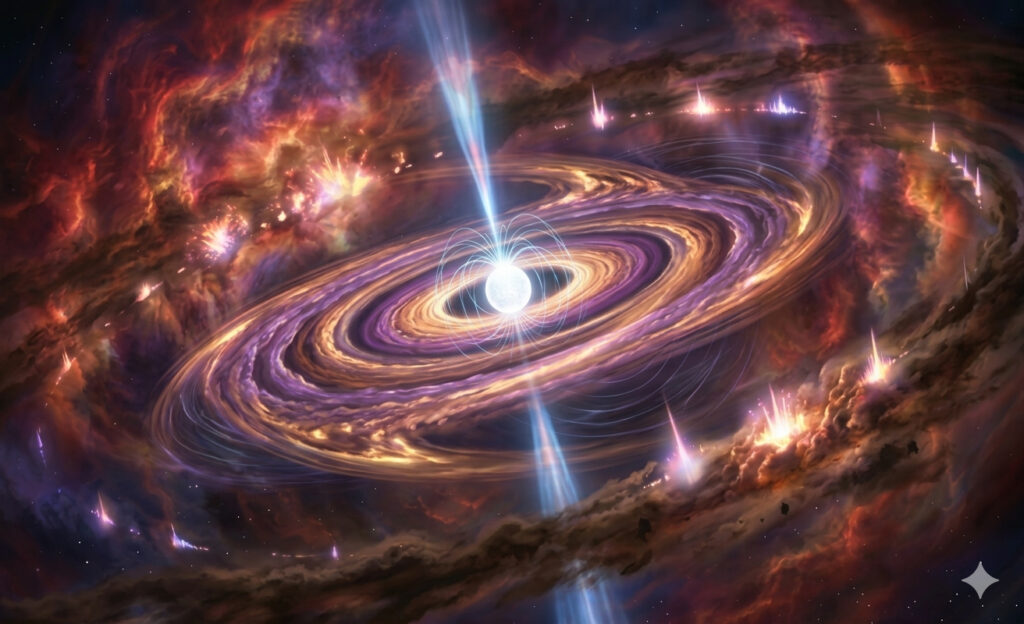
According to the model developed by Farah and his colleagues, material from the explosion fell back toward the newborn magnetar, creating an asymmetric accretion disk. Because a magnetar is a massive, rapidly spinning object, it literally drags the fabric of space-time along with it—a phenomenon known in General Relativity as Lense-Thirring precession.
This “frame-dragging” caused the misaligned accretion disk to wobble like a dying top. As the disk wobbled, it periodically blocked and reflected the magnetar’s light, creating a strobing effect. As the disk moved inward toward the magnetar, it wobbled faster and faster, causing the “chirp” observed by the telescopes on Earth. This marks the first time that General Relativity has been essential to describing the mechanics of a supernova.
The “Smoking Gun” Statistics
The data allowed astronomers to calculate the specifics of this newborn monster. The magnetar in the heart of SN 2024afav is roughly 10 miles in diameter, yet it possesses:
- A spin period of 4.2 milliseconds: Rotating hundreds of times every second.
- A magnetic field 300 trillion times stronger than Earth’s: A hallmark of the magnetar class.
Why This Matters for the Future
The confirmation of a magnetar birth does more than just solve a 20-year-old puzzle. It provides a direct link between superluminous supernovae and Fast Radio Bursts (FRBs), which are also thought to originate from magnetars.
Furthermore, this discovery sets the stage for the Vera C. Rubin Observatory. Once it comes online, astronomers expect to find dozens more of these “chirping” supernovae, allowing us to see if magnetars are the universal engine for all superluminous events, or just one of many ways a star can go out with a bang.
As Joseph Farah put it, this discovery is “the universe telling us out loud and in our face that we don’t fully understand it yet.” For now, however, we understand it just a little bit better.
References & Further Reading
Primary Source:
- Farah, J. R., et al. (2026). Lense–Thirring precessing magnetar engine drives a superluminous supernova. Nature, 651. https://doi.org/10.1038/s41586-026-10151-0
Key Researchers Involved:
- Joseph R. Farah (UC Santa Barbara / Las Cumbres Observatory)
- D. Andrew Howell (Las Cumbres Observatory)
- Alexei V. Filippenko (UC Berkeley)
- Peter Blanchard & Edo Berger (Northwestern / Harvard)
Data Access:
Detailed light curves and observation data for SN 2024afav are available via the Las Cumbres Observatory (LCO) global telescope network.