

The constellation Corona Borealis (the Northern Crown) is home to one of the most anticipated objects in modern observational astronomy: T Coronae Borealis (T CrB). Unlike most novae, which are observed only once in human history, T CrB is a recurrent nova. With a period of approximately 80 years, the system is currently on the verge of a new outburst, following its well-documented eruptions in 1866 and 1946.
The Binary System: An Unequal Pair
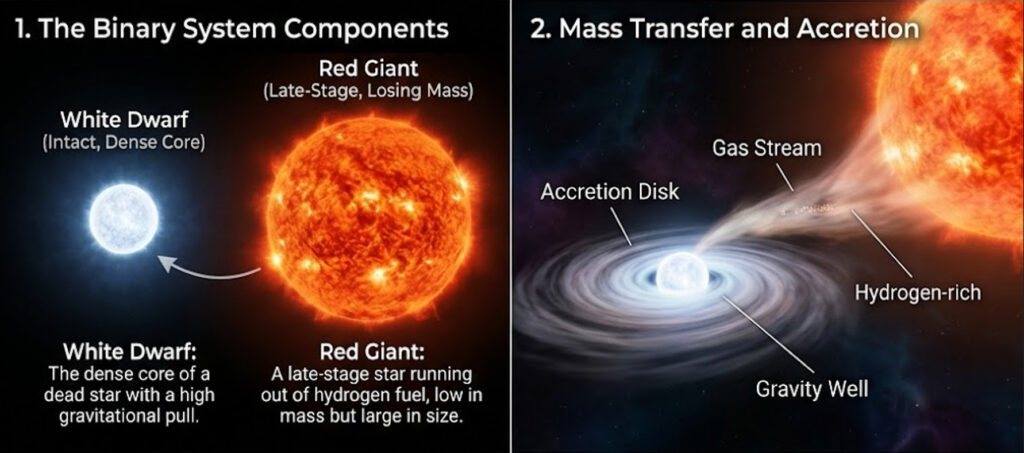
T CrB is not a single star but a close binary system consisting of a red giant and an extremely dense white dwarf. These two objects orbit each other at such a short distance that a continuous mass transfer occurs.
The red giant sheds matter from its outer layers, which accumulates in an accretion disk around the white dwarf. Due to the intense gravity of the white dwarf, this material – primarily hydrogen – is compressed and heated. When the pressure and temperature on the surface of the white dwarf reach a critical threshold, a thermonuclear runaway occurs. This violent explosion ejects the accumulated matter into space, causing the system to brighten by a factor of thousands within just a few hours.
Historical Context: 1866 and 1946
The history of T Coronae Borealis (T CrB) is exceptionally well-recorded. During both known outbursts, the system reached a peak apparent magnitude of approximately 2.0 mag. At this brightness, T CrB was clearly visible to the naked eye, rivaling Polaris (the North Star) in luminosity.
A characteristic feature of this nova is its extremely steep rise in brightness followed by a rapid decline. Historically, T CrB often exhibits a secondary maximum several months after the initial peak, making it a target of great interest for long-term photometric monitoring.
Current Status: The “Pre-Eruption Dip”
Why are astronomers worldwide focused on this star right now? Observations show that prior to the 1946 outburst, T CrB underwent a significant drop in brightness, known as a “pre-eruption dip.” An identical phenomenon has been documented since early 2023. This deviation from its quiescent brightness is considered one of the most reliable indicators that the thermonuclear process on the surface is nearing its ignition point.
Currently, T Coronae Boreealis (T CrB) remains in its quiescent phase at approximately 10.0 – 11.0 mag, making it a target for binoculars and telescopes including cameras. However, once the eruption begins, it will briefly become one of the brightest objects in the spring and summer sky.
Observation Details
T CrB is located in the constellation Corona Borealis, a distinctive semicircle of stars between Bootes and Hercules.
- Position (J2000): RA 15h 59m 30s, Dec +25° 55’ 13”
- Magnitude: approx. 10.0 – 11.0 mag
- Expected Peak Magnitude: approx. 2.0 mag
[PLACEHOLDER: LIVE UPDATE UPON ERUPTION]
This section will be updated as soon as the nova is detected.
Current Status (As of February 14, 2026): The system remains in its pre-eruption phase. No significant increase in brightness has been reported yet. Photometric monitoring is ongoing.
Outlook
T Coronae Borealis offers a rare opportunity to witness a stellar catastrophe in real-time. For the scientific community, this outburst is crucial for understanding the dynamics of mass transfer and the physical conditions on the surfaces of white dwarfs. For amateur astronomers, it promises to be one of the most spectacular celestial events of the decade.