

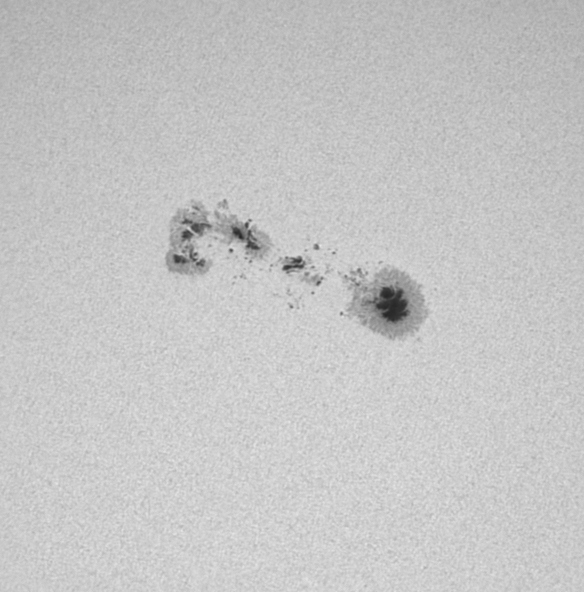
[Live Update: Feb 5, 2026 – 7:15 AM CET] The CME impact has begun! A shock reached the L1 point yesterday afternoon, with solar wind speeds jumping past 400 km/s. The Kp-index is currently rising through 4.33 (active). Despite poor seeing yesterday, our observations confirm that AR4366 maintains its volatile magnetic complexity. We expect the core of the CME to arrive today, potentially triggering a G2 (Moderate) geomagnetic storm with Kp values up to 6.
[Update: Feb 4, 2026 – 4:30 PM CET] Active Region AR4366 continues its explosive streak. At 12:13 UTC today, the sunspot unleashed yet another major X4.2 flare. Positioned near the center of the solar disk, this eruption is highly geo-effective, meaning any associated CME has a high likelihood of being Earth-directed.
Combined with the glancing blow expected from the Feb 1st X8.1 flare on February 5th, we are looking at elevated geomagnetic activity (G1-G2 levels). We are monitoring the solar wind speeds and will update on potential aurora visibility shortly!
It is February 2026, and the Sun has just delivered one of the most powerful statements of the current solar cycle. Active Region AR4366 – a behemoth sunspot that has grown rapidly over the last 48 hours – has officially entered “flare factory” mode.
Update 04.02.2026: AR4366 stays active and produced another X1.5 Flare yesterday.
On February 1st, satellites detected a massive X8.1 solar flare, followed closely by several other X-class eruptions. To put this in perspective: X-class flares are the most intense category of solar explosions, and an 8.1 magnitude places this event near the very top of the charts. AR4366 currently possesses a volatile “Delta-class” magnetic field, where opposing magnetic poles are packed so tightly together that explosive magnetic reconnection is continuously triggered.
The Forecast: Incoming CME
While the flare’s radiation reached Earth in just 8 minutes (causing radio blackouts over the Pacific), the main payload is still en route. A Coronal Mass Ejection (CME)—a billion-ton cloud of plasma—was launched into space and is predicted to reach Earth’s magnetic field around February 5th. Forecasters are predicting a “glancing blow” or potentially a direct hit, which could trigger G3 (Strong) or higher geomagnetic storms.
The Science of Light: Decoding the Colors
When this solar storm arrives, we hope for clear skies and auroras. But beyond their beauty, the colors of the Northern Lights serve as a scientific dashboard, indicating exactly what is happening in our upper atmosphere chemically and physically.
The colors are determined by which gas molecules are hit by solar particles and at what altitude these collisions occur.
1. The Standard Green (Oxygen)
The most common auroral color is a bright, ghostly green (557.7 nm).
- Molecule: Atomic Oxygen (O).
- Altitude: ~100 to 300 km (60-185 miles).
- The Science: When an oxygen atom is excited, it takes about 0.7 seconds to release that energy as green light. This is a “forbidden transition” in quantum mechanics. If the atmosphere were denser (like at ground level), the oxygen atom would collide with another molecule and lose its energy before it could emit the light. It only glows green in this specific “Goldilocks zone” of the thermosphere where the air is thin enough.
2. The Rare Deep Red (Oxygen)
In very intense storms—like the one AR4366 might produce—you may see a blood-red glow sitting on top of the green curtains.
- Molecule: Atomic Oxygen (O).
- Altitude: > 300 km (> 185 miles).
- The Science: This is also oxygen, but in a higher energy state. This transition is even slower, taking up to 110 seconds to emit a red photon. The atom needs to be left alone for nearly two minutes to glow red. This is only possible at the very edge of space, where the atmosphere is essentially a vacuum.
3. Purple and Pink (Nitrogen)
If the solar wind particles are moving with extreme speed (high kinetic energy), they punch deeper into the atmosphere, below 100 km.
- Molecule: Molecular Nitrogen (N2).
- Color: A mix of blue and red emissions, appearing as pink or purple to the eye.
- The Indicator: Seeing a purple fringe at the bottom of an aurora is a sign of a high-energy storm. Unlike oxygen, nitrogen emits its light instantly upon impact. This is why pink/purple features often dance and flicker much faster than the slow-moving red or green hazes.
Conclusion
The eruption of AR4366 is a reminder that we are living in a very active stellar neighborhood. As we wait for the CME impact around February 5th, we aren’t just watching pretty lights; we are observing high-energy particle physics interacting with our planet’s chemistry. Keep an eye out for that high-altitude red glow – it’s the signature of a truly powerful solar event.