
Mars: The Red Planet – Geology, Water, and the Future of Exploration
Overview and Key Characteristics
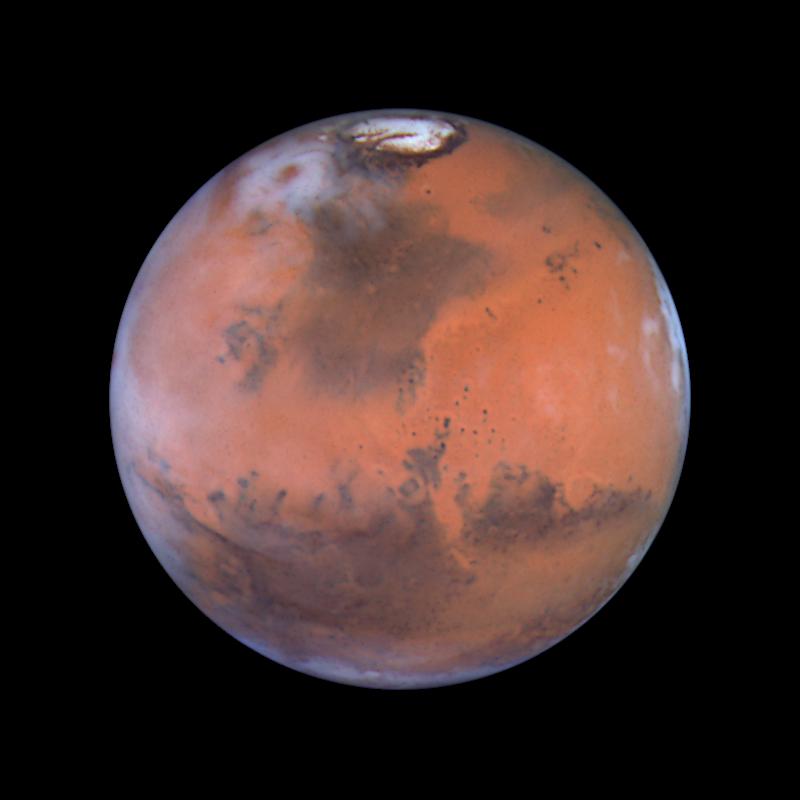
Mars is the fourth planet from the Sun and a terrestrial world distinguished by its pervasive reddish-orange – a result of oxidized iron (rust) covering its surface. Despite being a cold desert today, Mars shows compelling evidence that it was once warm and wet enough to support liquid water and potentially microbial life, serving as a vital key to understanding planetary evolution.
This search for our neighbor’s watery past has made it the most intensively explored terrestrial target beyond Earth. From early flybys to the sophisticated rovers currently traversing its surface, Mars remains at the forefront of human discovery. To delve deeper into these scientific milestones, explore our comprehensive overview of Current Mars Missions and the history of Mars’ exploration.
Planetary Data Table
| Characteristic | Value |
|---|---|
| Diameter | 6,779 km |
| Mass | 6.417 x 10^23kg (approx. 0.107 Earth masses) |
| Mean Distance from Sun | 227.9 million km (approx. 1.52 AU) |
| Orbital Period | 687 Earth days |
| Rotational Period (Day) | 24.6 hours |
| Surface Gravity | 3.71 m/s² (approx. 38 % of Earth’s Surface Gravity) |
| Atmosphere | 96 % Carbon Dioxide |
| Moons | 2 (Phobos and Deimos) |
Geology and Climate: A Dynamic Past
Mars exhibits a geological dichotomy that suggests a volatile past, driven by internal heat that has since largely dissipated. Because Mars lacks active tectonic plates—the mechanism that shifts crust on Earth—magma was able to erupt at the same location for millions of years, creating massive structures:
- Olympus Mons: Located in the Tharsis Montes region, this shield volcano stands approximately 22 km high (nearly three times the height of Mount Everest). Its immense size is a direct result of the stationary crust allowing lava to pile up over eons.
- Valles Marineris: This equatorial canyon system is a tectonic scar stretching over 4,000 km. Unlike Earth’s Grand Canyon, formed by water erosion, Valles Marineris is a rift valley caused by the stretching and cracking of the planet’s crust as the Tharsis region swelled.
- Atmospheric Conditions: The Martian atmosphere is tenuous, composed of 95% carbon dioxide, with less than 1% of Earth’s surface pressure. This lack of insulation leads to extreme temperature fluctuations, ranging from -140°C in winter to 20°C in summer. The atmosphere is also too thin to block solar ultraviolet radiation.
- Global Dust Storms: Despite the thin air, thermal differences can drive winds capable of lifting fine iron-oxide dust. These localized “dust devils” can occasionally coalesce into planet-encircling dust storms that obscure the surface for months, drastically altering the planet’s thermal profile.
The History of Water on Mars
The most compelling aspect of Martian science is the transition from a wet, potentially habitable world to a cold desert. This history is divided into geological eras, with the Noachian period (over 3.7 billion years ago) showing the strongest evidence for abundant liquid water.
- Geomorphological Evidence: Satellites have mapped extensive ancient river valley networks, outflow channels, and dried river deltas that could only have formed under a thicker, warmer atmosphere.
- Mineralogy: Robotic rovers like Curiosity have identified phyllosilicates (clays) and sulfates—minerals that form in the presence of liquid water—confirming that standing bodies of water existed for long durations.
- Current Reservoirs: Today, liquid water is unstable on the surface due to low pressure (it would sublime instantly). However, water remains abundant as ice in the permanent polar caps and in vast, sub-surface permafrost layers. Recent radar data suggests that large deposits of ice may be buried deep within the Medusae Fossae Formation.
Mars Moons: Phobos and Deimos
Mars possesses two small satellites, Phobos and Deimos, named after the mythological sons of Ares (Fear and Terror). Unlike Earth’s Moon, these are likely captured C-type asteroids from the outer asteroid belt, rich in carbon and ice, though impact-origin theories are also debated.
- Phobos: The larger and closer moon is heavily scarred by the Stickney Crater. It orbits below the synchronous orbit radius, meaning it rises in the west and sets in the east. Tidal forces are slowly dragging Phobos inward; in approximately 30 to 50 million years, it will cross the Roche Limit and disintegrate, likely forming a temporary ring system around Mars.
- Deimos: The smaller, outer moon orbits further away. Conversely to Phobos, tidal forces are causing Deimos to slowly drift away from the planet, eventually destined to escape Martian gravity entirely.
Astrobiology and Future Exploration
The primary driver of Mars exploration is the search for biosignatures—chemical or physical signs that life once existed. While the surface is currently hostile to life as we know it, the ancient lakebeds of craters like Gale and Jezero offer prime hunting grounds for fossilized microbial life.
Human Settlement: Long-term goals involve establishing a sustainable human presence. This requires solving critical challenges, such as radiation shielding and in-situ resource utilization (ISRU)—specifically, extracting water and oxygen from Martian ice and the CO2 atmosphere.
Robotic Geologists: Rovers like Perseverance are currently drilling into sedimentary rocks to cache samples. These samples are hermetically sealed and deposited on the surface for a future retrieval mission.
Mars Sample Return (MSR): A complex multi-agency campaign is being planned to launch these cached samples into Mars orbit and return them to Earth for analysis in advanced laboratories.